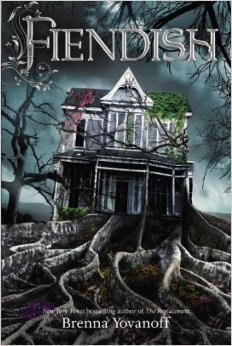
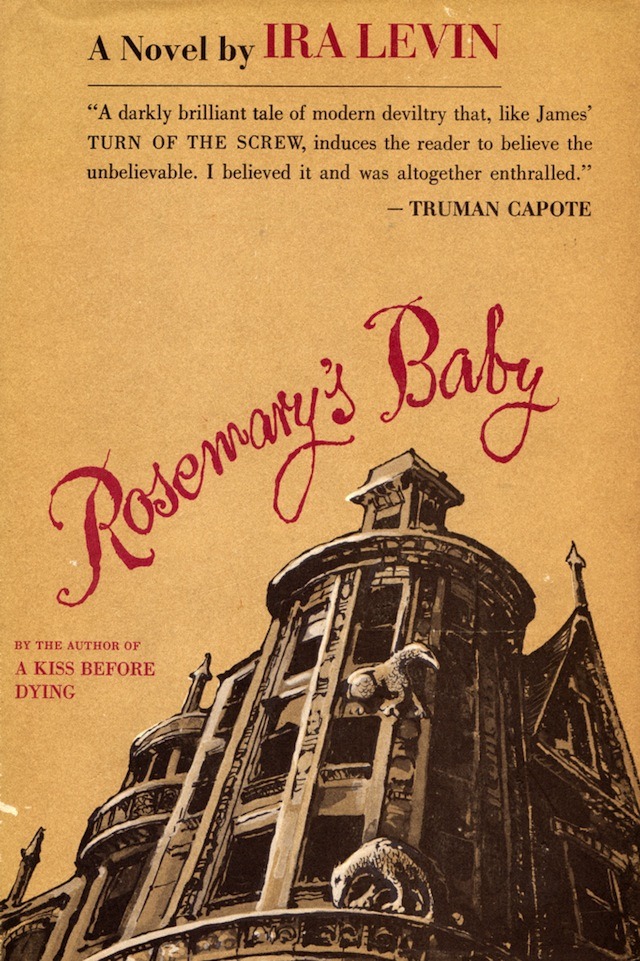
Fiendish by Brenna Yovanoff New York: Razor Bill 2014 341 pages
I have seen a newish trend in teen fiction emerging--the Southern Gothic. Maybe it's not so new, since we have seen popular books like Beautiful Creatures by Kami Garcia, and from my earlier review, Spirit and Dust by Rosemary Clement-Moore, but I have seen more of this particular sub-genre in the reviews. This is my first Brenna Yovanoff book, but I am eager to read more.
Fiendish is an entertaining Southern Gothic with a paranormal twist. I found these elements of the Gothic Novel very nicely outlined by Robert Harris. Here's their application to this novel.
We have the actually have several large and spooky houses. We have the burnt-down house in which Clementine was found. We have her aunt Myloria's decrepit house. We also have Fisher's grandmother's house, with the mysterious rooms in the attic.
The first element of mystery in this story is how did Clementine get into the cellar closet and subsequently survive, and who put her in there?
There are ancient prophecies, omens, portents, and visions in abundance about the "Crooked people" of Hoax County. The return of the Reckoning, when the town's people tried to burn out the Blackwoods' home, is what people of the craft are afraid of.
There are many supernatural elements: how did Clementine survive all of those years in the cellar? What about the hollow and the fiends? And the hell dogs are deadly.
The high, overwrought emotion is everywhere in this story: Aunt Myloria's strange behavior, the animosity between the village and the hollow dwellers, the overwhelming sense of doom, all contribute to the highly charged emotional level of the story.
Women in distress is also a common theme in the Gothic novel. Clementine, her cousin Shiny, friend Rae and, most of all, Davenport, all are threatened by the past, the town's people, the hollow fiends, and even each other.
The metonymy of doom and gloom. We have plenty of metaphors in the wind howling, the rain flooding the rivers, and the dark smoke of the burning buildings.
And the use of language to create a dark and tense atmosphere.
The spooky, swampy hollows
As a Gothic horror story, this story was exciting and intense. I really enjoyed the side romance, too, with Clementine and Fisher, brought together in the beginning of the story by some mysterious connection. It's the typical teen romance, on again off again, but also rather intense as Clementine is so drawn to her rescuer. The characters face their opponents with strength and determination, and although we aren't quite sure how it will end, we know our story's heroes will put up a good fight. I did wonder
I recommend this book for any teen reader who likes horror stories but doesn't mind a touch of the supernatural.
starring Mia Farrow, John Cassavetes, and Ruth Gordon
Directed by Roman Polanski 1968 136 minutes Rated R
Rarely has a movie so closely duplicated a book. I recently read the Ira Levin novel about Rosemary, her husband Guy, their unusual neighbors Minnie and Roman Castavet, and the baby we never see but are all waiting for with anticipation. I had seen the movie several times, and it is definitely one of the horror classics that everyone should see eventually.
Usually when we are comparing movies to the books on which they are based, we lament all of the details and, sometimes, total major story elements, that are lacking from the movie version. With Rosemary's Baby, there are many elements that were included that we readers don't always think about, from Rosemary's hair style, the colors in the nursery, the print of her dress, the decor of Minnie Castavet's living room. Roman Polanski was very conscientious about incorporating Ira Levin's details into the movie.
Reading the book after seeing the movie, then, was like reading the script.
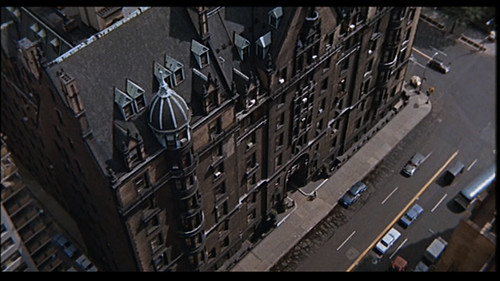
Rosemary and Guy are married. Guy is an actor and has performed in off-Broadway plays and in television commercials. He isn't exactly unsuccessful, but he has ambitions. I think Rosemary, although not exactly mousey, definitely thinks life revolves around Guy. The pair find a new apartment in a large and very creepy apartment building. We are meant to think it's creepy, and their friend, Hutch, tries to convince the Woodhouses of the creepy factor with his dinner conversation, but they are convinced that it is a good address and a bargain.
"The Bramford" aka The Dakota, New York City
All seems to go well in the beginning of the movie. The couple moves in, they beautify the apartment, Rosemary makes curtains and cushions, and Guy, although he doesn't get one part he wants, gets some other minor parts. Then Rosemary meets the girl who is staying with the old couple next door while she is doing the laundry in the dismal basement. This event, too me, seems to be the catalyst that changes the Woodhouses lives, and not for the better.
Guy and Rosemary meet the Castavets at the death scene of Terri, the girl who lived with them but mysteriously jumped out of the window. We wonder, as does Rosemary, why this nice, lively girl who seemed to have everything going for her, would commit suicide like this, as if she was trying to get away from something horrible in her apartment. And what about the Castavets? The first view of Minnie and Roman Castavet is quite memorable. They stand out in their polyester, brightly colored clothes, and what's not to love about Minnie's turban? I suspect even in 1967/1968, they were unusual looking. I am reminded of descriptions of the dandies of 18th Century Bond Street.
This initial meeting leads immediately into dinner the next day. Little does Rosemary know, but her ambitious husband has been quickly appraised by the Castavets as weak and suitable for their purpose. He is easily swayed to give away his wife to their plan for the fame they can offer. Poor Rosemary. She deserves so much better than that.
Once we know about the baby on the way, we are struck with the disparity between Rosemary's hopes and plans for a normal pregnancy and healthy baby and the symptoms she is exhibiting that are unusual and shocking. We know something bad is going to happen and that the baby won't be the Andy or Jenny that Rosemary wants and envisions.
I think the book does a bit better at explaining Rosemary's past religious life, her feelings about the nuns at school, and her indecision about God and religion in general. I think she is so in love and insubordinate to Guy, who seems quite atheistic. Rosemary quietly echoes the irreverent statements of Guy and, to a lesser degree, the Castavets, at their dinner parties, but I think she is really uneasy about what she hears them say.
Another thing that struck me is the difference between the Mother of the Son of God and the mother of the son of Satan. Mary was asked if she would be the mother of the Savior of the World and, when asked, said "Yes." Rosemary, on the other hand, was NOT asked and never agreed to it. If asked, she would have said, "NO!" I rather think this is a story flaw, and I think it would have been a more interesting and complicated story to try to trick Rosemary into saying "Yes."
Here is the original trailer:
For those of you who are interested in what happens to Rosemary and her baby, there is a sequel written by Ira Levin in 1997. "Andy" is grown up now and Rosemary has been in a coma, thanks to Roman Castavet, to keep her out of the way in the rearing of the devil child. I am not going to tell you more, but the sequel is actually quite disappointing, especially since Rosemary's Baby is a horror classic. The ending is really just plain stupid, a complete "cop out".