Showing posts with label gothic. Show all posts

Sunday, February 22, 2015

The Coldest Girl in Coldtown


The Coldest Girl in Coldtown
by Holly Black
New York: Hachette Audio
2013
Read by Christine Lakin
10 sound discs (12 hours)


For the last few weeks, I have been listening to this book in the car. By popular author, Holly Black, this is one of the best vampire stories I have heard in a long time. No wonder it was voted one of the best fiction books for young adults by the Young Adult Library Services Association (YALSA), and an amazing audiobook for young adults (also by YALSA) in 2014. It is on several lists of best horror fiction for teens, too.

This story starts out with a horrific bang. Tana, a 17-year-old, wakes up following a party only to discover that all of the other teens have been brutally murdered. As she wanders through the house, she looks for other survivors but only finds blood and guts everywhere. Yes, it is rather graphic. Then she opens a door to a bedroom. There she sees Aidan, a young man (and former boyfriend, it turns out) chained to a bed. In the other bed is another boy, but this guy is different. Tana can tell immediately that he is a vampire.

This is how we find out what sort of story this is. The victims of the house party were mutilated by thirsty, very savage vampires, who purposely left Aiden and Gavriel, the "boy" vampire in the bedroom.

Tana has moments to figure out what she should do. How can she get away? She doesn't know where the vampires are in the house, but she knows they are there, probably sleeping off their glutonous feast since it is still the remains of the day. That doesn't leave her much time. And what she she do about the vampire who is tied up?

Springfield is the Coldtown of our story.
Through the masterful telling of this story, we learn that events such as the party massacre are not unusual. Vampires are real and out there, but society has mostly dealt with them by locking them into various "coldtowns", called such because of the sickness and feeling that takes over one's body as it changes. Coldtowns are all over the United States, and people on the outside can see in through the active use of social media.

There seems to be the impression that Coldtowns are fun, party towns where vampires live forever, dancing and feasting. This lifestyle is appealing to some young people who escape into the Coldtowns hoping to be changed and party forever, only to die tragic deaths as food for the vampires who eat too quickly. Not all victims will be turned, however, but only those who are bled slowly and then have a chance to feed themselves.

I was particularly pleased with Holly Black's more traditional portrayal yet updated of vampires. They are seen as mesmerizing and erotic to their victims, once bitten. They also sleep in the day, can't survive in the daylight, and also have an uncontrollable need to feed. Her descriptions of their ability to sense the blood around them, in living victims, is very vivid and helps us to understand the immediate change in the brain, once the person becomes infected. These are very much ancient vampires who have adapted well to the clubbing activities of many teens, using this as the means to entice new meals into Coldtowns.

The story as to who Gavriel is, and the conflicts between him and the ancient and powerful Coldtown vampire, Lucien, is well described and exciting. Tana and Gavriel are attracted to each other, something no other vampire in the story expected since Gavriel has been known during his long life as being maniacally cruel, a history Tana did not know before she rescued him from the farmhouse party. This leads to some interesting plot twists.

I hate to think of Tana, who was infected during her time in Coldtown and must wait to see if she changes, as being a vampire forever. She has a humanity that most of the characters, human and vampire alike, lack. But we know that she will "survive" any way that she can, and maybe make Coldtown a better place.

Here is a book trailer for you about the story:


I recommend this book for older teens, maybe high school and up, who love traditional vampire stories. Some of the gore in the story, as well as the intensity of the violence, might be too much for younger readers.

Monday, September 29, 2014

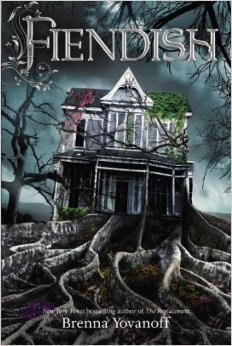
Fiendish


Fiendish
by Brenna Yovanoff
New York: Razor Bill
2014
341 pages


I have seen a newish trend in teen fiction emerging--the Southern Gothic. Maybe it's not so new, since we have seen popular books like Beautiful Creatures by Kami Garcia, and from my earlier review, Spirit and Dust by Rosemary Clement-Moore, but I have seen more of this particular sub-genre in the reviews. This is my first Brenna Yovanoff book, but I am eager to read more.

Fiendish is an entertaining Southern Gothic with a paranormal twist. I found these elements of the Gothic Novel very nicely outlined by Robert Harris. Here's their application to this novel.

  • We have the actually have several large and spooky houses. We have the burnt-down house in which Clementine was found. We have her aunt Myloria's decrepit house. We also have Fisher's grandmother's house, with the mysterious rooms in the attic.
  • The first element of mystery in this story is how did Clementine get into the cellar closet and subsequently survive, and who put her in there?
  • There are ancient prophecies, omens, portents, and visions in abundance about the "Crooked people" of Hoax County. The return of the Reckoning, when the town's people tried to burn out the Blackwoods' home, is what people of the craft are afraid of.
  • There are many supernatural elements: how did Clementine survive all of those years in the cellar? What about the hollow and the fiends? And the hell dogs are deadly. 
  • The high, overwrought emotion is everywhere in this story: Aunt Myloria's strange behavior, the animosity between the village and the hollow dwellers, the overwhelming sense of doom, all contribute to the highly charged emotional level of the story.
  • Women in distress is also a common theme in the Gothic novel. Clementine, her cousin Shiny, friend Rae and, most of all, Davenport, all are threatened by the past, the town's people, the hollow fiends, and even each other.
  • The metonymy of doom and gloom. We have plenty of metaphors in the wind howling, the rain flooding the rivers, and the dark smoke of the burning buildings.
  • And the use of language to create a dark and tense atmosphere.
The spooky, swampy hollows
As a Gothic horror story, this story was exciting and intense. I really enjoyed the side romance, too, with Clementine and Fisher, brought together in the beginning of the story by some mysterious connection. It's the typical teen romance, on again off again, but also rather intense as Clementine is so drawn to her rescuer. The characters face their opponents with strength and determination, and although we aren't quite sure how it will end, we know our story's heroes will put up a good fight. I did wonder

I recommend this book for any teen reader who likes horror stories but doesn't mind a touch of the supernatural.

Thursday, August 28, 2014

Ammie, Come Home


Ammie, Come Home
by Barbara Michaels
New York: HarperCollins
2009
352 pages
eBook version

I may have told you before that I discovered Barbara Michaels' books when I was a teen. I have loved her gothic thrillers ever since and when I am looking for a comfort book to read, I often will pull out one of her titles. This month I reread the old favorite, Ammie, Come Home. Although it seems rather dated, with the references to hippie culture, I still find the historical ghost story appealing.

Ruth Bennett  lives in a beautiful old Georgian home in Georgetown. She has inherited it from an older relation whom she didn't know that well, but Ruth loves the history and elegance of the neighborhood and the house. She has recently invited her niece, Sara, to come live with her while she attends the nearby university, and she is glad for the company. But this is when things start to happen in the house.

A Georgian-style Home

It is little things that begin to unnerve the two women. A lonely voice in the night calling, "Ammie, come home!" awakens Sara, who wonders what small pet is lost in the dark. There is a feeling of cold in the parlor that is uncomfortable but not unbearable to both women.

Then Ruth meets dashing Pat McDougal, professor of Sara, who invites her to his mother's home for dinner. There she meets a famous medium--of course!--and promptly and uncharacteristically invites her to her own home to do a reading.This is when the true haunting begins!

The ghost story develops well, with the characters doing their historical research on the house to see if they can find out who is stuck there. It turns out that it is more than one ghost anchored there due to a past tragedy, which leads to confusion and difficulties for Ruth and Sara, along with their friends, Pat and Sara's boyfriend, Bruce. The ghostly possessions and apparitional appearances increase in frequency and intensity until we reach a terrifying climax.

Although this book, first published in 1968, is somewhat dated in some ways and I never quite forget that I am reading a story about characters in the hippie '60s, I think the characters are developed well  I feel connected to them. It is rather strange and unbelievable, however, how quickly the relationship between Ruth and Professor Pat progresses. But because I like Ruth and Pat, I can disregard the swiftness of their romance.

During this reading, I discovered that Ammie, Come Home had been made into a television movie! It stars legends Barbara Stanwyck and Richard Egan. The House that Would Not Die (1970) changes the story somewhat. There is still a house, but it is in the country, not the city, and Ruth has left her job for a time to decide if she wants to live there. Sara is there with her, but it is unclear why she is hanging out with her auntie in the country since the college connection is lost. Pat McDougal is now a neighbor, and there is no Mrs. Mac, his mother, the hostess with the most-est in Georgetown. She is replaced with with an aunt who is far more bland. Bruce, the boyfriend, is mysteriously replaced by Stan, and I confess that I don't like him much.

Despite these changes, I greatly enjoyed the movie and considering it was made for television, it is a satisfying ghost story for a Saturday afternoon. It is divided into parts on Youtube. Here is part one for you to get started:


An added bonus for me in finding The House That Would Not Die was finding the Youtube station TV Terror Land. Imagine finding 1970s-1980s scary television shows that you thought you would never see again! There will be more reviews on some of those shows later!

Friday, March 21, 2014

Thorn Abbey


Thorn Abbey
by Nancy Ohlin
New York: Simon Pulse
2013
295 pages


The title of this new teen horror book reminded me of Gothic horror favorites, alluding to Thornfield in Jane Eyre by Charlotte Bronte and Northanger Abbey by Jane Austen. But the story is essentially a remake of Rebecca by Daphne Du Maurier, one of my all-time favorite books. Could this book live up to it? Well, not really because the goal is too high, but it is an entertaining story nevertheless.

Tess is a shy, insecure, mousey, and very ordinary girl who transfers to Thorn Abbey, a prestigious boarding school. Her new roommate, Devon,  seems friendly at first, until the mention of Max de Villiers comes up. Max was her former roommate, Becca Winters', boyfriend, but Becca died tragically and Max is heartbroken so leave him alone.

Of course, there is an instant connection between Max and Tess and despite Devon's dire warnings, they begin to date. But weird things start to happen to Tess. She hears crying in her dorm room when no one is crying. Someone tries to burn her at the bonfire. The girls' lounge is vandalized. And Max is moody and won't talk about Becca. Tess feels uncertain about his feelings and thinks he is broken up about Becca, who was seemingly perfect in every way.

Thorn Abbey might be like Fettes College,
a prestigious boarding school in Edinburgh, Scotland

The original Rebecca in the Daphne Du Maurier haunts Manderly more figuratively and "gets her revenge" on Max from beyond the grave through a set of circumstances and the mind of a crazy housekeeper. But I she is not an actual spirit walking the halls. Becca Winter, however, is portrayed here as a real ghost with revenge in mind on Max and the school, possessing her former roommate, Devon, and causing her to carry out her deadly schemes from the afterlife.

I think I found the original story far more disturbing. We can easily imagine the young Mrs. de Winter -- young, naive, happy to leave a life of servitude but frightened of the grandiose life she now finds herself thrown into. Everywhere she goes she hears about the perfect Rebecca, the dead wife of her new husband who won't talk about her. How could anyone live up to that? Rebecca doesn't have to do anything at all to be disturbing to us, but having Mrs. Danvers around to emphasize the new wife's inadequacies compared to her beloved Rebecca makes the story even creepier.

Thorn Abbey is a readable story that hangs together well enough, although I found the ending rather silly, like a B horror movie ending. One possession was enough for me. I think teens 14-16 will enjoy the boarding school premise, as well as the ghostly occurrences, even if they haven't read the original classic.

Tuesday, October 15, 2013

The Last Will and Testament of Rosalind Leigh


The Last Will and Testament of Rosalind Leigh
starring Aaron Poole, Vanessa Redgrave 
Directed by Rodrigo Gudiño
2012
84 minutes
Unrated

Here is a very unique ghost story by Canadian director, Rodrigo Gudiño, making his debut into horror movies with The Last Will and Testament of Rosalind Leigh. This movie has one actor on the screen for the entire film, a man named Leon Leigh (Aaron Poole), the estranged son of Rosalind who has just died. Rosalind is still present in the house and we hear her story told by Vanessa Redgrave who tries to explain her situation to her son.  Besides the physical presence of Leon and the voice presence of Rosalind, we have a third major character, the atmospheric presence of Rosalind's astonishing and eerie house.

Rosalind Leigh, a member of a strange angel cult called God's Messengers, has just died in mysterious circumstances. Her son, Leon, an antiques dealer comes to her home, a house he has never visited while she lived there as Rosalind's voice informs us, to tidy up her estate. When he arrives he finds a house overwhelmingly full of antiques, many of them religious in nature. We also learn through a phone call that Rosalind has been buying up antiques that Leon has sold through his business agent, and Leon is naturally unhappy to find out that his mother has purchased these items, supporting him without his knowledge.

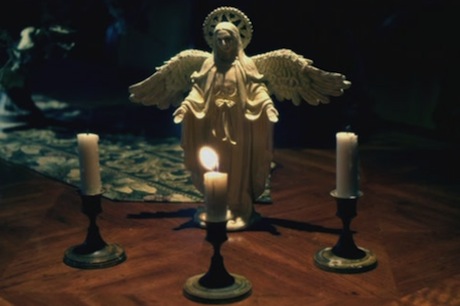
"Do you believe in angels?"
Through the course of the movie, we learn more about why Leon left home and refused to see his mother. Leon's father, another cult member, committed suicide, but the cult leaders were exonerated. His mother continued in the cult, trying to indoctrinate her son, her own "angel", into the cult beliefs. She had a ritual "game of candles" that she would use to try to get Leon to say he believed or else the angels among us would turn his back on him and he would lose their protection. It didn't work and he rejected her beliefs and eventually ran away never to return.

We follow Leon's exploration of the house. The camera shots are very interesting throughout the movie, not only following Leon's action, but panning the rooms showing all of artifacts of Rosalind's life. The set designer was very good at designing a house that is crowded without being absolutely cluttered, and also creating a very gothic atmosphere. Here and there are more personal touches left by Rosalind, including her photograph and several wall samplers with mysterious adages placed around the house that add to the ominous feeling.

"If a fork, it will be neither a man nor woman."
You might think this would be a boring movie, just following this guy around an old creepy house, looking at old stuff. But then things happen that are unexplained. Leon takes some items down to the basement and finds an angel figurine that brings back unpleasant memories of the "game of candles". When he heads back upstairs, the lights go out, so he heads back to look for the fuse box. Then the lights go back on. We see the angel figurine again on the television in the living room and Leon panics and calls his former girlfriend/psychiatrist. She talks him down from the panic, but things are not the same for Leon in the house. He has an visitor at the door (after dropping a fork during dinner), a neighbor who is also a cult member who tries to get Leon to come to a meeting. We see Rosalind's video on television of a meeting that shows evidence that she was still heavily involved in the mysterious cult. Watch out for the large angel statue, though.

Inside Rosalind Leigh's bedroom shrine
Leon finds the key to his mother's bedroom inside the angel figurine and unlocks the door. It is an odd room with a stairway down into darkness. Of course Leon goes down the stairs and we must follow. There we find the scene of the video, full of angel figures and other religious symbols. What was this room really used for?

The scariest part of the movie is the monster that comes from the back garden. It looks dog like and ferocious, and we think that Leon has managed to lock it out, but it somehow gets into the house, terrorizing him in his sleep. What unearthly creature is it? Maybe it is the loneliness that Rosalind hints at that "ate" her alive, waiting for her son to come back to her.

The ending of this movie was a surprise for me. I won't give it away, but part of the horror is that we are left wondering who really is the ghost here. Is it Rosalind, the dead woman who has been talking to us and her son after her death? Is it Leon, who may or may not have really been in the house at all? Or is it the house itself? Maybe it's all three. Watch and decide for yourself.


Sunday, September 22, 2013

Spirit and Dust

New Hardback Cover
Old Cover


Spirit and Dust
by Rosemary Clement-Moore
New York: Delacorte Press
2013
387 pages

Which cover do you like better?

I used to watch the television series Medium and have in fact been watching it again on Netflix. When I read the blurb about this book, I thought immediately of that program. This is a teen version of that basic premise, the psychic who helps law enforcement solve crimes. It is also book two, following Texas Gothic, about the Goodnight Clan. I didn't know this when I started reading, but Spirit and Dust is a good stand-alone book, so it won't matter so much if you read this one first, as I did.

Daisy Goodnight is a very modern teenager in many ways. She has dyed red hair, likes Goth clothing, and has an "kick-ass" attitude. But she is also very connected with the past. She is from a long family line of psychics who can talk to spirits, or remnants. These are not the souls of the dearly departed, but leftover fragments of the dead, associated with places they had been or where they died, or things they had touched. Daisy is asked by FBI Agent Taylor to assist with the murder of the driver of a kidnapped teen. Another wrinkle to the problem is that the teen is the daughter of a mobster, Devlin Maguire. Daisy is able to talk to the remnant of the driver but all she learns that there was something unusual and disturbing about this death.

Anubis, Egyptian God
of the Afterlife
Soon afterwards, Daisy is herself kidnapped and taken to the home of the crime boss dad. He wants Daisy to get busy and find his daughter. He offers the service of Carson, a young man who knows a lot about Alexis Maguire's habits, and a witch named Lauren. Lauren puts a binding spell on Daisy so she can't just hightail it out of there at the first opportunity. With Carson's help, Daisy and Carson escape and follow up a lead provided by Alexis's dead grandmother to the cemetery where they find a mysterious flash drive. Daisy now finds herself on the run with Carson, but the binding spell is still activated and Daisy must continue searching for Alexis.

All is not as it seems in this quick-moving, intense horror thriller. In searching for clues to the Alexis' disappearance, we encounter many dead people including archaeologists, Cleopatra, and the Egyptian God Anubis. Carson and Daisy's adventures lead them to several interesting places in the Midwest, including the St. Louis Art Museum, the Oriental Institute, and my favorite, the Field Museum. I was surprised to find out the truth about the Maguires and the part they play in Daisy's misadventures. Daisy is a likeable character, but I don't think her talent is thoroughly explored or explained very well. Perhaps if I had read the first book, I would understand her better. She has an "attitude" and is rather mouthy, or "kick-ass" as she puts it, which is somewhat explained by her age. I guess I myself sympathize with Agent Gerard, the agent who doesn't want to put up with the teen medium's smart aleck opinions on everything, since teen attitudes like this can get tiresome after awhile, at least to this mother of teenagers.

Sue the T-Rex, Field Museum, Chicago
My favorite part of this book, however, was not the spooky ghost bits with the spirits or the Jackal, but the descriptions of Sue, the Tyrannosaurus and the Field Museum. I love Sue, as most visitors do, and have marvelled at how large she is and how sharp her teeth look. And when Daisy reanimates Sue's bones so that she can chase down the bad guys, I can't help but think of the final scenes of the movie Jurassic Park, in which the T-Rex is running around inside the Park's welcome center. That would be a truly horrifying experience!

Tuesday, September 17, 2013

The Awakening


The Awakening
starring Rebecca Hall, Dominic West, 
and Imelda Staunton
2011
107 minutes
Rated R

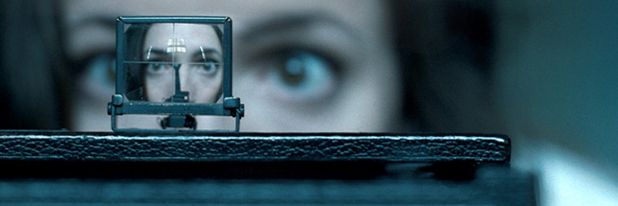
This weekend was a good movie-watching one for me. Besides The Picture of Dorian Gray, a classic movie based on a classic book, I watched a "haunted house" film, my favorite type of horror movie. This one, called The Awakening, was filmed at Lyme Park, a beautiful yet eerie National Trust house in the Peak District in England. There are very few satisfying haunted house movies, especially recently, and the English seem to do it so much better than anyone else. This movie is no exception. It may have its flaws, but I found it quite satisfying and suitably spine-tingling.

The time is 1921. England is still recovering from the massive loss of life in World War I, and everywhere people are searching for comfort from spiritualists. Rebecca Hall plays Florence Cathcart, a ghost hunter who specializes in exposing phony mediums. She has written a book on the subject and is known for her expertise and intelligence.

Directly after a successful and exhausting hunt, Florence is visited by Robert Mallory (Dominic West), a teacher at a boys' boarding school where a child ghost has been seen by many of the boys. The ghost has appeared in the class photographs over the years, and the headmistress of the school (Imelda Staunton), a devotee of Cathcart's book, would like her to come and investigate.The catalyst of the request, however, is a recent death of student and the other boys are convinced that the ghost had something to do with it. Despite Florence's exhaustion from her last hunt, she is intrigued by the case and agrees to go with Mallory to the boarding house.

Once at the boarding house, we learn that it used to be a private home and a young boy had died there. Using the latest ghost-hunting apparatus, Florence quickly discovers the non-ghostly cause of the student's death. The case is closed and she packs up and prepares to leave. The school is shut down for half-term and all of the boys depart, all but one. 

Strange things begin to happen directly to Florence. She sees someone in the lake and falls in. She sees scary little dolls in a dollhouse version of the boarding school that look like people in the school, set in scenes from her activities.She sees a boy where none should be, and flashes of other people appear. Things like this aren't supposed to be happening to a realist like Florence. Add a budding romance between Florence and Robert Mallory, a rather odd headmistress, and a psychotic groundskeeper and you have the makings of a really satisfying old-fashioned ghost story.

Here is a trailer for the movie. The R rating is for scariness, nudity and sexual content.


After watching movie, I was interested to learn more about the location of the boarding school. Lyme Park is a National Trust home and you can visit. Here is a website to learn more. Fans of Jane Austen movies will recognize it as Pemberly, the estate of Mr. Darcy in Pride and Prejudice (1995, Colin Firth and Jennifer Ehle).

Lyme Park, Disley, Cheshire, England


Since I am also interested in art, I was interested to see another spooky painting in this movie. "It came with the building, it's the boys' favorite." Mallory thinks it is a painting of the beheading of John the Baptist, but erudite Florence corrects him and identifies it as Judith Slaying Holofernes, taken from the biblical story of Judith in which she kills the Assyrian general after he has fallen asleep drunk, thus delivering the Kingdom of Israel. Many painters have dealt with this bloodthirsty topic, including Titian, Rembrandt, Caravaggio, Donatello, and others but the painting shown in the movie is by the Italian early Baroque artist Artemisia Gentileschi (1611-12) and is especially gory with blood. It doesn't refer to any other part of the movie's story but is just another interesting fact, perhaps to illustrate Florence's intelligence.

You might also be interested in listening to the entire hymn,  Be Still My Soul, which is sung in the movie and uses the beautiful theme from Finlandia by Finnish composer, Jean Sibelius.

Sunday, September 15, 2013

The Picture of Dorian Gray

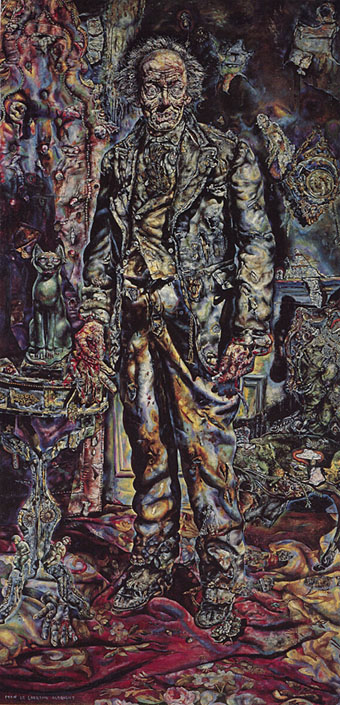
The Picture of Dorian Gray, Ivan Albright, 1945
The Art Institute of Chicago
This past week I went to one of my favorite places, the Art Institute in Chicago, and saw this painting by Ivan Albright, The Picture of Dorian Gray (1945). It was painted for the movie based on Oscar Wilde's only novel with the same title, directed by Albert Lewin and starring George Sanders, Hurd Hatfield, Donna Reed, and Angela Lansbury. On its own, this painting portrays an unreal and disturbing monster of a person, his clothes are slashed, stained, and decayed. The colors of the painting are strangely muted, not as bright as one might think blood and gore should be, but they are also more organic looking as a result. And this is a painting that developed organically.

In the movie, filmed in black and white, there are a few moments of color. The first comes when we get to see the painting of Dorian that his friend, Basil Hallward, had just completed. It shows a young gentleman who is self-assured, talented, wealthy, upper-class, and flawless.

Portrait of Dorian Gray, painted by Henrique Medina
 for the movie The Picture of Dorian Gray (1945)
In the story, Dorian Gray meets and befriends another friend of Basil's, Lord Henry Wotton, whose world view is based on hedonism and the fulfillment of the senses. All experiences are worth having, good and bad, without considering  the consequences to others. I am not quite sure how this works into his other opinion that seeking Youth and Beauty are of the highest value in life, since I do not associate bad or evil experiences as a way  to finding Youth or Beauty. Dorian likes his portrait and wishes that he could always be young and beautiful while his portrait would change. Lucky for him (or unfortunate for him, as the case may be), there just happens to be a little statue of Bastet, the Egyptian cat-goddess nearby. She appears in the portrait to Dorian's right. Perhaps we are meant to think that Bastet is sympathetic to the search for Youth and Beauty and wishes to give Dorian what he wants, or perhaps she might feel that he is foolish to wish for something like this and wants to teach him a lesson.

Dorian's infatuation with Sibyl Vane is a good example of his incorporating Lord Henry's philosophy into his own life. His infatuation with Sibyl and then his rejection of her at the advice of Lord Henry, in the guise of a test, shows that Dorian doesn't comprehend, although he might still care at this point, what he represented to Sibyl. She is desperate for a way to leave her life of singing in the little club, and her mother seems to constantly tell her that she deserves better. When "better" finds her and Dorian offers her a way out, she snatches it eagerly despite the inequality of their situations. But Sibyl is not willing to go against her moral standards to be with Basil and certainly does not expect to be rejected so utterly.

The next shocking flash of color comes when we again see the portrait. Absorbing all of the vices of the model, the painting has become gross, decayed, and terrifying. We haven't seen Dorian commit many crimes during the story and movie; we only know that 18 years have passed since Sibyl's death. We can only imagine the atrocities he has committed over the years. Of course, the horror of his murdering his friend Basil on top of the seduction of young innocent Gladys Hallward, who naively things that just because Dorian is so good looking, the things people say about him can't be true, are only a small sample of Dorian's vices. But the ending of the story proves that there can be redemption after all but at what price? This painting has come to represent his soul, what he has become deep inside and hides from the world. Can anyone this ugly and horrifying inside be capable of caring for anyone but himself? Will Gladys end up like poor Sibyl?

I thought Hurd Hatfield was a good choice for Dorian. I was particularly struck by how mask-like his face is throughout the movie, so smooth and wrinkle-free. But to have a face like this, it would imply that this person also doesn't show any emotion. Smiles cause wrinkles, too, and Hurd as Dorian doesn't ever seem to smile or laugh. Does he enjoy his life? Perhaps he is not capable of it.

If you haven't seen this movie, I recommend it but not as a substitute for the novel by Oscar Wilde. That is a classic of literary horror and shouldn't be missed.

The Albright painting was painted with the Medina portrait as the base. I wish the Art Institute had both of them side by side to show the contrast. Without the other, Albright's painting is a ghoulish painting that exemplifies a life spent in evil pursuits, or maybe it is just another zombie picture. Nasty but interesting. We don't understand the message of the book without the "original" to compare to it.

Friday, August 30, 2013

Wait for What Will Come


Wait for What Will Come
by Barbara Michaels
first published in 1978
about 280 pages, depending on edition

As I mentioned in an earlier blog entry, one of my favorite authors, Barbara Michaels aka Elizabeth Peters, died this month. The books she wrote under her pseudonym Barbara Michaels are gothic thrillers, usually with a supernatural connection. I want to read many of these over again, some I haven't read since high school. The first I read was Wait for What Will Come because I had it on my nook already.

Carla Tregellas is the last of an old Cornish family. She is tracked down by a lawyer and learns that she has inherited the old family mansion in Cornwall. There is no money with the legacy to take care of the place, and it's in bad shape, but Carla decides to go and spend her summer vacation there learning about her heritage before it has to be sold. It will be an exciting opportunity that this math teacher may never have again!

I imagine the Tregellas mansion on a Cornish cliffside similar to this.

Upon her arrival, the elderly housekeeper shrieks and practically faints. "It is Lady Caroline back from the dead!" Who is Lady Caroline, you might ask? We learn that Lady Caroline Tregellas disappeared 200 years ago and was said to have been kidnapped by a selkie on Midsummer's Night and taken to his watery kingdom, never seen or heard from again. And now it is going to happen again and Carla will be taken away by the selkie, or at least that is what Mrs. Pendennis the housekeeper believes!

I think some of you might not know about the selkies. Mythological creatures found in Faroese, Icelandic, Irish and Scottish folklore, selchies (silkies, selchies) live as seals in the sea but shed their skins on land to become human. In the stories, male selkies kidnap human women to be their wives and take them to sea. This is the legend explored in this book. For more on the selkies, this Wikipedia article will be helpful.

Carla has a lot to put up with in this story. We have Mrs. Pendennis, the elderly housekeeper who can hardly bear to look at Carla because of the curse and Lady Caroline. Then we have Mike, Mrs. Pendennis' grandson who is living in the house and taking care of the garden. Carla thinks he is surly, but she is also attracted to him. Mike used to be a fairly well-known dancer, so why he is here mucking about? He tells Carla that he would like to buy the house with his mysterious friend, Tim, but he hopes she will take payments.

Other love interests are Allan, the suave lawyer who has been entrusted to advise Carla on estate matters. Also Simon, a folklore-loving local doctor who is only too happy to tell Carla all about the selkie story. Then we also have John, the local vicar, who is keen on solving the mystery of Lady Caroline in time to save Carla from a similar fate.

This book has all of the elements of a good gothic thriller: the spooky house of doom, the archetypal hero (although at first we don't quite know which of the four young men is the hero), and the portent of evil. Despite the rather corny possibilities this could lead to, Carla is a very level-headed young lady who is not easily frightened. Although I somewhat doubt that any young woman could receive so many marriage proposals within such a short time, having only met all three men within a couple of months of their declarations, it works in the story, especially when you find out which one(s) are not sincere.

The ending of this story, which I am not going to give away, leaves us wondering if there might not be some truth to the selkie story after all. I heartily approve of Barbara Michaels' leaving us with this possibility. Some things are just better left unexplained. 

Tuesday, August 27, 2013

Rebecca

"Last night I dreamt I was at Manderley again...."

Rebecca
by Daphne Du Maurier
first published in 1938

Rebecca
directed by Alfred Hitchcock
starring Joan Fontaine, Laurence Olivier George Sanders, and Judith Anderson
1940

Rebecca by Daphne Du Maurier is the only book I had to read again directly after finishing it for the first time because the "book withdrawal" was too painful. I could not stand the idea that I was finished with the story, that I was unable to spend more time with the characters of Maxim and the unnamed Mrs. de Winter and find out what happens next with them. I knew what happened to them, since that is explained somewhat in the beginning of the story, but I was having a hard time getting my brain from the dramatic burning of Manderley to the de Winters' life in exile. I guess Maxim and Mrs. de Winter must have had the same problem, since they couldn't bear the thought of even going back to England to live somewhere else. You would think, though, that Mrs. de Winter would be rather happy that the house haunted by the past was destroyed and they could finally be free from Rebecca.

And Manderley is definitely haunted. Everywhere we look there are signs of the title character, Rebecca, the first Mrs. de Winter. We don't have to meet her or see her ghost, she is there everywhere for us to run into unexpectedly. Her name is on the stationery in the morning room, her monogram is on the table linen, her name is invoked by the servants, and even the dog misses her. Who could match up to somebody who was so talented, beautiful, involved, and organized? Certainly not the new Mrs. de Winter, who is a little mouse of a girl, much younger than her new husband and totally unused to life in a large house as a society wife.

This is a story about bad marriages. We eventually come to find out just how bad the marriage is between Max and Rebecca, despite appearances, but what about the marriage of Maxim and his new much younger wife? It doesn't have the best of beginnings, with a casual proposal and a joke about white frocks and conservatories. Our narrator thinks so little of herself that she doesn't expect a more affectionate proposal; this one was a complete surprise, and I think it means much more to our narrator than to Maxim. I also think Maxim's disregard of his new wife's feelings and experience shows that he has not embarked on a better, more equal marriage. She hesitatingly tries to tell him about her fears and inadequacies, but he pushes them aside without really listening. Mrs. de Winter asks him several times throughout the story if they are really happy together, that their marriage is a success. I think if she has to ask, it probably isn't.

But our biggest sign that this new marriage is not a "marriage of true minds" is that Maxim never once tells his new wife about his real feelings for Rebecca. Mrs. de Winter would not ask him herself, she is too insecure and has had heard from Mrs. Van Hopper about how devoted Max was to Rebecca. He didn't have to confess to her death, but he could have and should have told his new wife that their relationship was not paradise on earth. I know he wants to forget Rebecca and the disaster of their marriage and her death, but how could he not prepare his new wife for what she would face at Manderley? What total insensitivity! And it would have saved a lot of trouble later. But then what would happen to the story? Where would it be without that conflict and uncertainty?! Okay, I admit it, without Maxim being an insensitive man, the story wouldn't be nearly as interesting.

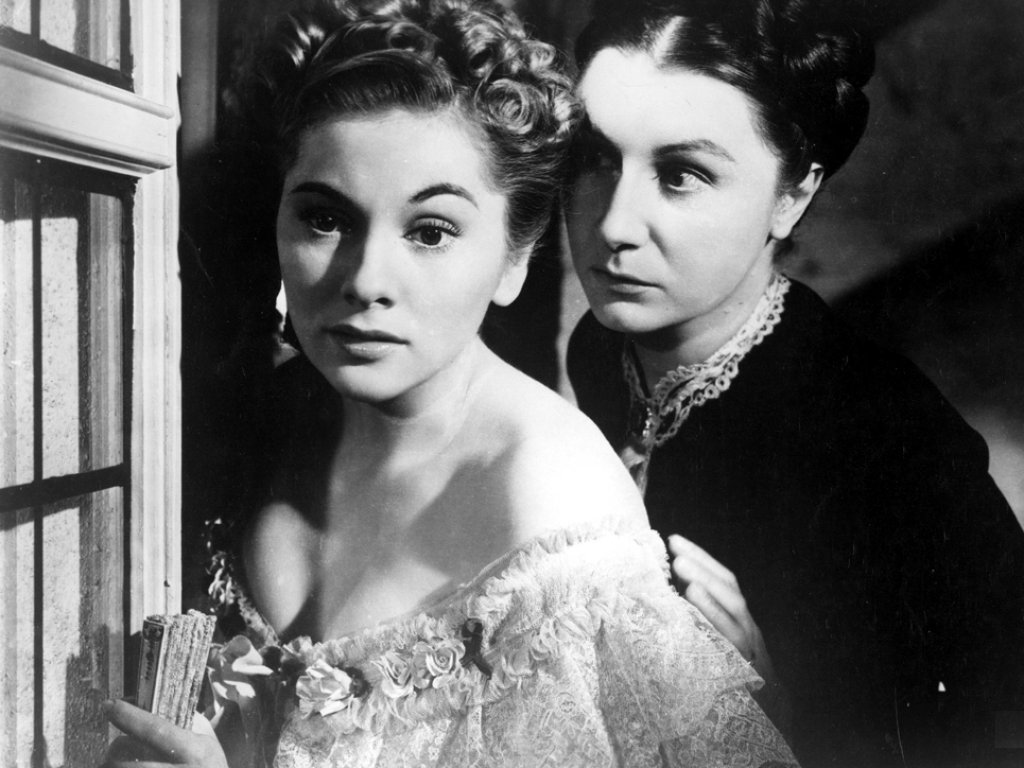
Recently I showed the Alfred Hitchcock version of Rebecca (1940) during my public library Classic Movie series. This movie won an Academy Award as Best Picture (Hitchock's only Best Picture win), and rocketed Daphne du Maurier's book to its place as one of the best gothic horror stories of all time. How does it compare to the book? Well, for me it has good points and bad points.

Laurence Olivier and
Joan Fontaine
The main stars of this movie are Laurence Olivier and Joan Fontaine, with Judith Anderson and George Sanders. I think Laurence Olivier is superb as the suave, sophisticated, wealthy, broody Max de Winter. Joan Fontaine, however, does not match my mental image of the new Mrs. de Winter. First of all, she is much too pretty, I think. The age difference between these two actors is or seems minimal, whereas the book characters are definitely about twenty years apart. Also, Joan Fontaine does not come across as a gauche girl/woman who doesn't know much about the herself, let alone society.

The true star of the book and the movie is Mrs. Danvers, played in the movie by Judith Anderson. Mrs. Danvers is the epitome of the creepy housekeeper. She may be good at her job and seems to run Manderley quite well, but she is the main reason that Rebecca is allowed to haunt the house. She enshrines Rebecca in the West Wing, keeping everything just as it was on Rebecca's last night. She constantly refers to Rebecca and the way she wanted things done. Strong people like Maxim might think that Mrs. Danvers' obsession with Rebecca is normal since she was with her from the time Rebecca was a girl. As long as the house runs smoothly! But how could a new wife unaccustomed to running a household or servants deal with this obsession? Obviously, Mrs. de Winter can't. She is absolutely terrorized by Mrs. Danvers, not only by her inexperience, but Mrs. Danvers' subtle campaign against her.

What could Mrs. Danvers (Judith Anderson) be whispering
 to Mrs. De Winter (Joan Fontaine)
I think that Rebecca's true character is subdued in the Alfred Hitchcock movie--in the book, she is much worse. She is like the rose in William Blake's poem:

O Rose thou art sick.
The invisible worm,
That flies in the night
In the howling storm:
Has found out thy bed
Of crimson joy:
And his dark secret love
Does thy life destroy.
But the worm inside her not only destroyed her life, it very nearly destroyed everyone around her.

If you enjoy stories about the complexities of relationships, as well as how people can affect each other even after death, you will find this story intriguing. Add to that the scary big house, the crazy housekeeper, the mystery of Rebecca's death, and the haunting and you have all the makings of a very satisfying ghost story.

Saturday, August 17, 2013

R.I.P. Barbara Michaels / Elizabeth Peters

One of my favorite authors died last week. Barbara Mertz, otherwise known as Barbara Michaels and Elizabeth Peters, died at the age of 85. She wrote some of the best Gothic horror stories of the 20th Century, which I discovered as a teen. Now I am motivated to reread as many of them as I can. The first on my list is Wait for What Will Come, which I already have on my nook. I will give you a synopsis and review about this later, when I finish reading it again.


Besides Gothic horror stories, Barbara/Elizabeth wrote the admirable mysteries about Amelia Peabody Emerson. I learned nearly all I know about Egyptology from Amelia, and her sense of humor always left me in stitches! I also loved the other series about Jacqueline Kirby, librarian par excellence, and Dr. Vickie Bliss, beautiful and super-smart art historian/detective. Barbara/Elizabeth certainly had a way of making her characters memorable and well-developed, lol.

Interconnected and inseparable with my reading of Barbara Michaels'/Elizabeth Peters' stories, is listening to the audiobook versions, read by one of the best narrators out there, Barbara Rosenblat. She definitely has a knack of making exciting stories even more exciting! I often forget that it is one reader I am hearing, since her voice changes are so quick, consistent, and completely different. I just love it when she does her Schmitt voice in the Vickie Bliss stories, or her Amelia P. Emerson voice! Barbara adds dimension to the characters through her reading.

Here is the website to learn more about Barbara Michaels/Elizabeth Peters and her books. I know I will be tracking down the older iInes through interlibrary loan and amazon. I am also including a link to Barbara Rosenblat's homepage with info on her audio books (you will want to hear them all, just so you can listen to Barbara's voice changes).