Showing posts with label New York City. Show all posts

Saturday, January 18, 2014

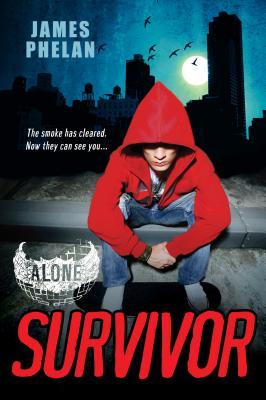
Survivor


Survivor
Book Two in the Alone Trilogy
by James Phelan
New York: Kensington Publishing Corp.
2011
242 pages


This second book in the Alone Trilogy by Australian author, James Phelan, continues the story of Jesse, an Australian teen who had come to New York City for the United Nations Youth Camp, only to be propelled into a large-scale city-wide, if not worldwide, disaster. He was alone in the GE Building at 30 Rockefeller Plaza at the end of the first installment of the story and had decided to try to find other survivors. In his search, he had stopped at the apartment nearby and discovered the video evidence of another possible survivor, a girl named Felicity. Jesse became determined to find her, but how? Jesse was worried that she had headed into Central Park, the best possibility for survivors but also a congregating site of many Chasers--the survivors who chase any other humans they see in order to catch them and drink their blood.

Early in the story, Jesse encounters a military truck full of soldiers. These men are not here to rescue survivors, however, but to quarantine the infected Chasers and survivors together. They offer no explanation to Jesse for what has happened or how he can get back home. Jesse begins to lose hope as the men move on, shooting Chasers and knocking down more buildings.

Afterwards, Jesse meets Rachel, an intern who is the lone survivor at the Central Park Zoo. She is trying to take care of the animals by herself with limited resources. Her living arrangements are inadequate and not nearly as safe as what Jesse had experienced at 30 Rockefeller Plaza. Fortunately for her, Jesse is not afraid to go out to try to get more food and supplies for her and the animals. But how to get Rachel to join him in his search for Felicity and other survivors? Her sense of responsibility for the animals is very strong.



Jesse also finds another young man named Caleb who has been living comfortably in a bookstore. Caleb entices Jesse in from his search for food and supplies with offers of generator-cooked food, company, and potential help with the heavy lifting back to the zoo. Caleb means well, but he keeps Jesse too long while Rachel is alone and worrying about him. It comes out okay, however, and Caleb does help with the supplies and eventually a generator for the animal care.

We eventually find Felicity, who is also happy to find other survivors. She understands Rachel's commitment to the animals better than Jesse, I think. But Jesse still feels the need to go out to find more survivors and help.

The disturbing part of this story is that the Chasers seem to be getting smarter about tracking victims. They follow people and then revisit their safe places later unexpectedly. The blood drinking Chasers seem to be getting stronger, with more endurance, becoming quite dangerous to Jesse and the others. To make matters worse, the mysterious military men set off another missile containing the mysterious virus, so anyone in its vicinity who wasn't exposed previously is now at risk.

Despite the craftiness of the Chasers and the lack of explanation for the disaster, I still have an interest in the story. I want Jesse to find a way out of this trouble, and now I especially want help for Rachel and the animals. Adding cute zoo animals to the story will do that to me. I appreciated the toned-down descriptions of the zombie/vampire-like infected humans, unlike those I read in the Ilse Bick trilogy, so I think this story can appeal to a much younger audience.

I recommend this book for ages 12 and up.

Wednesday, January 8, 2014

Chasers


Chasers
by James Phelan
New York: Kensington Publishing Corp.
2010
213 pages


Chasers is the first in the dystopian Alone trilogy by Australian author, James Phelan. His Australian protagonist, Jesse, is 16 years old and visiting New York City for the first time in order to attend a United Nations camp for Youth Ambassadors. He and his new acquaintances--Dave, Mini, and Anna--are travelling on the subway with other camp attendees to see the sights, when disaster strikes. Jesse sees a fireball coming down the tunnel and hears the explosion before the train derails and tips over. Darkness envelops the teens and when they find their flashlights, they discover many people are dead or just not there anymore.

When the four make it out of the subway tunnels, the scene before them is devastating. Hundreds of cars had crashed into each other, buildings are demolished, and there are craters instead of streets. Some people are milling around, but they are not behaving normally. Jesse watches as they drink from puddles, but then he notices a few people hunched over the dead bodies, drinking their blood. What has happened on their subway ride? The teens have to run fast to get away from these "chasers" who will track people and attack them.

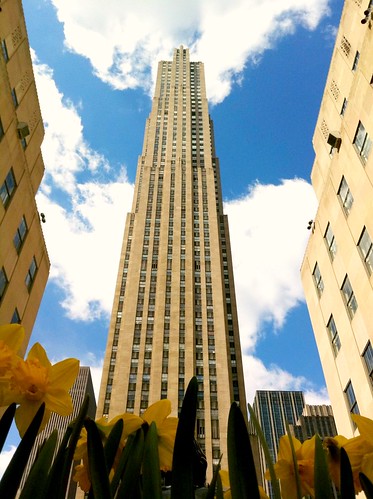
The teens hide on the
70th floorof
the GE Building,
Rockefeller Plaza, NYC
Jesse and the others find refuge in one of the only skyscrapers remaining intact, the GE Building at 30 Rockefeller Plaza. Fortunately, they find plenty to eat in the Rainbow Room restaurant, and there is an observation deck near the top of the building. Being 70 floors above the destroyed city gives them a sense of safety and also a view of the devastation. Not much is left and the few people they see seem to be the strangely-behaved "chasers" who attack those who are only drinking water or the few "normal" people.

The rest of the story outlines the friends' exploration of the building, their discussions about what could have happened to cause the massive ruination of the large city, and their tentative excursions into the outside world looking for a way out.

I'm not going to give away the surprise at the end. I'll just say that I was not expecting what I learned, and certain things mentioned along the way then made sense. This book, however, clearly is only the beginning of the story. Why are the car batteries drained making the cars unusable? Why are buildings collapsed and collapsing, even two weeks after the initial event? And what happened to all of the people? Most of the people are just gone, and those that remain seem to have a strange sickness that forces them to drink all the time. Are there any other survivors, and how will these kids find them?
The Rainbow Room where Jesse, Dave,
Anna, and Mini go after the big disaster.

This was a well-written story for teens, ages 12 and up, and typical of the dystopian genre. I felt connected to the main character, Jesse, who is the main focus of the story. The other characters seem less developed, but that is to be expected if they are only supporting characters. The violence of the Chasers is not described in gory detail, but we still can feel the horror of the situation in which these teens now find themselves.

I am excited to get to the next book in the series.

Saturday, November 16, 2013

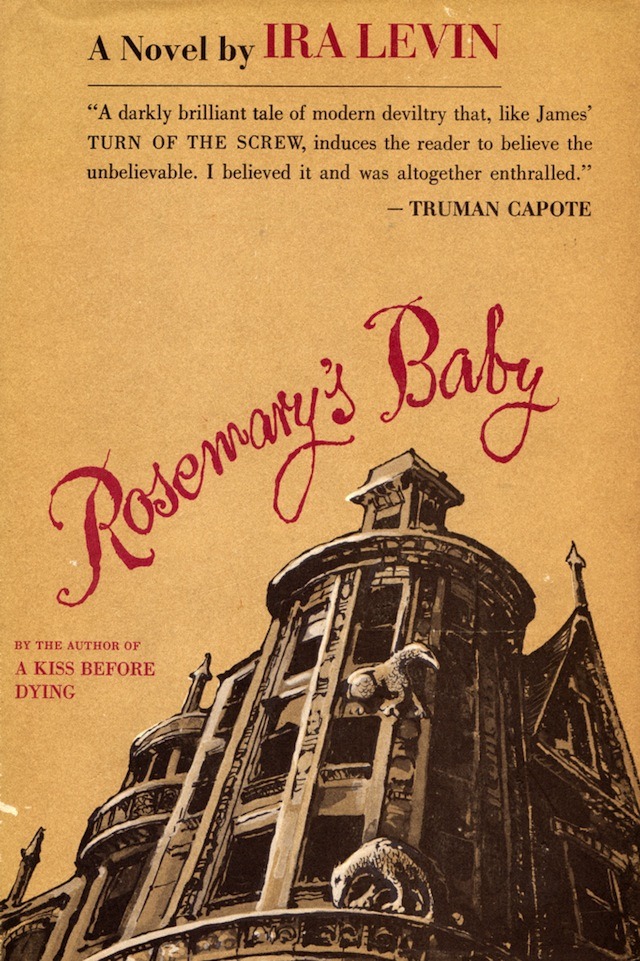
Rosemary's Baby


Rosemary's Baby
by Ira Levin
New York: Random House
1967

Rosemary's Baby
starring Mia Farrow, John Cassavetes, and Ruth Gordon
Directed by Roman Polanski
1968
136 minutes
Rated R

Rarely has a movie so closely duplicated a book. I recently read the Ira Levin novel about Rosemary, her husband Guy, their unusual neighbors Minnie and Roman Castavet, and the baby we never see but are all waiting for with anticipation. I had seen the movie several times, and it is definitely one of the horror classics that everyone should see eventually.

Usually when we are comparing movies to the books on which they are based, we lament all of the details and, sometimes, total major story elements, that are lacking from the movie version. With Rosemary's Baby, there are many elements that were included that we readers don't always think about, from Rosemary's hair style, the colors in the nursery, the print of her dress, the decor of Minnie Castavet's living room. Roman Polanski was very conscientious about incorporating Ira Levin's details into the movie.

Reading the book after seeing the movie, then, was like reading the script.

Rosemary and Guy are married. Guy is an actor and has performed in off-Broadway plays and in television commercials. He isn't exactly unsuccessful, but he has ambitions. I think Rosemary, although not exactly mousey, definitely thinks life revolves around Guy. The pair find a new apartment in a large and very creepy apartment building. We are meant to think it's creepy, and their friend, Hutch, tries to convince the Woodhouses of the creepy factor with his dinner conversation, but they are convinced that it is a good address and a bargain.

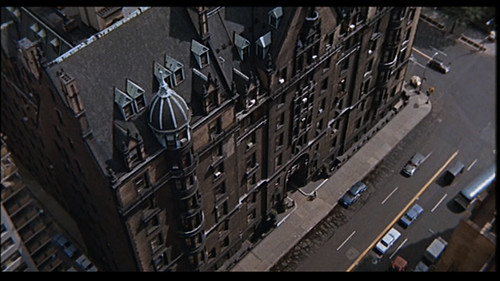
"The Bramford" aka The Dakota, New York City
All seems to go well in the beginning of the movie. The couple moves in, they beautify the apartment, Rosemary makes curtains and cushions, and Guy, although he doesn't get one part he wants, gets some other minor parts. Then Rosemary meets the girl who is staying with the old couple next door while she is doing the laundry in the dismal basement. This event, too me, seems to be the catalyst that changes the Woodhouses lives, and not for the better.

Guy and Rosemary meet the Castavets at the death scene of Terri, the girl who lived with them but mysteriously jumped out of the window. We wonder, as does Rosemary, why this nice, lively girl who seemed to have everything going for her, would commit suicide like this, as if she was trying to get away from something horrible in her apartment. And what about the Castavets? The first view of Minnie and Roman Castavet is quite memorable. They stand out in their polyester, brightly colored clothes, and what's not to love about Minnie's turban? I suspect even in 1967/1968, they were unusual looking. I am reminded of descriptions of the dandies of 18th Century Bond Street.


This initial meeting leads immediately into dinner the next day. Little does Rosemary know, but her ambitious husband has been quickly appraised by the Castavets as weak and suitable for their purpose. He is easily swayed to give away his wife to their plan for the fame they can offer. Poor Rosemary. She deserves so much better than that.

Once we know about the baby on the way, we are struck with the disparity between Rosemary's hopes and plans for a normal pregnancy and healthy baby and the symptoms she is exhibiting that are unusual and shocking. We know something bad is going to happen and that the baby won't be the Andy or Jenny that Rosemary wants and envisions.

I think the book does a bit better at explaining Rosemary's past religious life, her feelings about the nuns at school, and her indecision about God and religion in general. I think she is so in love and insubordinate to Guy, who seems quite atheistic. Rosemary quietly echoes the irreverent statements of Guy and, to a lesser degree, the Castavets, at their dinner parties, but I think she is really uneasy about what she hears them say.

Another thing that struck me is the difference between the Mother of the Son of God and the mother of the son of Satan. Mary was asked if she would be the mother of the Savior of the World and, when asked, said "Yes." Rosemary, on the other hand, was NOT asked and never agreed to it. If asked, she would have said, "NO!" I rather think this is a story flaw, and I think it would have been a more interesting and complicated story to try to trick Rosemary into saying "Yes."

Here is the original trailer:


For those of you who are interested in what happens to Rosemary and her baby, there is a sequel written by Ira Levin in 1997. "Andy" is grown up now and Rosemary has been in a coma, thanks to Roman Castavet, to keep her out of the way in the rearing of the devil child. I am not going to tell you more, but the sequel is actually quite disappointing, especially since Rosemary's Baby is a horror classic. The ending is really just plain stupid, a complete "cop out".