Showing posts with label Dorian Gray. Show all posts

Sunday, September 15, 2013

The Picture of Dorian Gray

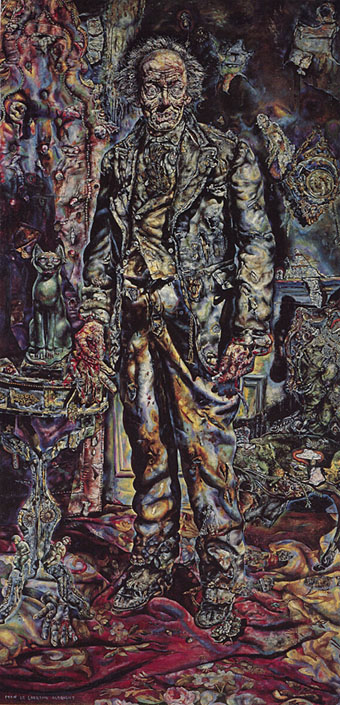
The Picture of Dorian Gray, Ivan Albright, 1945
The Art Institute of Chicago
This past week I went to one of my favorite places, the Art Institute in Chicago, and saw this painting by Ivan Albright, The Picture of Dorian Gray (1945). It was painted for the movie based on Oscar Wilde's only novel with the same title, directed by Albert Lewin and starring George Sanders, Hurd Hatfield, Donna Reed, and Angela Lansbury. On its own, this painting portrays an unreal and disturbing monster of a person, his clothes are slashed, stained, and decayed. The colors of the painting are strangely muted, not as bright as one might think blood and gore should be, but they are also more organic looking as a result. And this is a painting that developed organically.

In the movie, filmed in black and white, there are a few moments of color. The first comes when we get to see the painting of Dorian that his friend, Basil Hallward, had just completed. It shows a young gentleman who is self-assured, talented, wealthy, upper-class, and flawless.

Portrait of Dorian Gray, painted by Henrique Medina
 for the movie The Picture of Dorian Gray (1945)
In the story, Dorian Gray meets and befriends another friend of Basil's, Lord Henry Wotton, whose world view is based on hedonism and the fulfillment of the senses. All experiences are worth having, good and bad, without considering  the consequences to others. I am not quite sure how this works into his other opinion that seeking Youth and Beauty are of the highest value in life, since I do not associate bad or evil experiences as a way  to finding Youth or Beauty. Dorian likes his portrait and wishes that he could always be young and beautiful while his portrait would change. Lucky for him (or unfortunate for him, as the case may be), there just happens to be a little statue of Bastet, the Egyptian cat-goddess nearby. She appears in the portrait to Dorian's right. Perhaps we are meant to think that Bastet is sympathetic to the search for Youth and Beauty and wishes to give Dorian what he wants, or perhaps she might feel that he is foolish to wish for something like this and wants to teach him a lesson.

Dorian's infatuation with Sibyl Vane is a good example of his incorporating Lord Henry's philosophy into his own life. His infatuation with Sibyl and then his rejection of her at the advice of Lord Henry, in the guise of a test, shows that Dorian doesn't comprehend, although he might still care at this point, what he represented to Sibyl. She is desperate for a way to leave her life of singing in the little club, and her mother seems to constantly tell her that she deserves better. When "better" finds her and Dorian offers her a way out, she snatches it eagerly despite the inequality of their situations. But Sibyl is not willing to go against her moral standards to be with Basil and certainly does not expect to be rejected so utterly.

The next shocking flash of color comes when we again see the portrait. Absorbing all of the vices of the model, the painting has become gross, decayed, and terrifying. We haven't seen Dorian commit many crimes during the story and movie; we only know that 18 years have passed since Sibyl's death. We can only imagine the atrocities he has committed over the years. Of course, the horror of his murdering his friend Basil on top of the seduction of young innocent Gladys Hallward, who naively things that just because Dorian is so good looking, the things people say about him can't be true, are only a small sample of Dorian's vices. But the ending of the story proves that there can be redemption after all but at what price? This painting has come to represent his soul, what he has become deep inside and hides from the world. Can anyone this ugly and horrifying inside be capable of caring for anyone but himself? Will Gladys end up like poor Sibyl?

I thought Hurd Hatfield was a good choice for Dorian. I was particularly struck by how mask-like his face is throughout the movie, so smooth and wrinkle-free. But to have a face like this, it would imply that this person also doesn't show any emotion. Smiles cause wrinkles, too, and Hurd as Dorian doesn't ever seem to smile or laugh. Does he enjoy his life? Perhaps he is not capable of it.

If you haven't seen this movie, I recommend it but not as a substitute for the novel by Oscar Wilde. That is a classic of literary horror and shouldn't be missed.

The Albright painting was painted with the Medina portrait as the base. I wish the Art Institute had both of them side by side to show the contrast. Without the other, Albright's painting is a ghoulish painting that exemplifies a life spent in evil pursuits, or maybe it is just another zombie picture. Nasty but interesting. We don't understand the message of the book without the "original" to compare to it.

Thursday, August 22, 2013

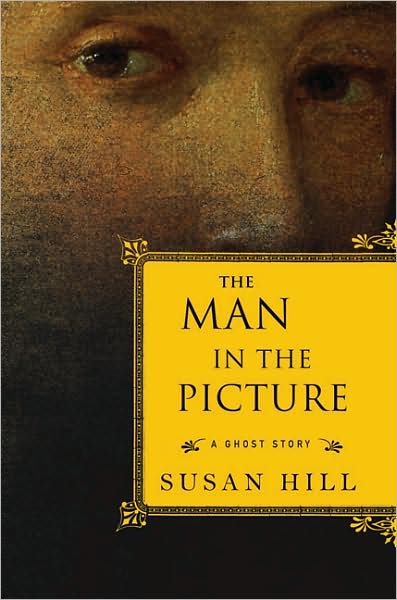
The Man in the Picture


The Man in the Picture
by Susan Hill
Woodstock, N.Y.: The Overlook Press
2007
145 pages


Another book I read this summer was The Man in the Picture by Susan Hill. I had read Susan Hill's most famous book, The Woman in Black, and really enjoyed it as a deliciously satisfying ghost story. I was attracted to check out The Man in the Picture story because of the painting aspect. My son is an art major and we visit a lot of art museums. The concept of haunted paintings is also one I have seen before in other books.  The Picture of Dorian Gray by Oscar Wilde is a story about a decadent man who stays young but his picture deteriorates into a horrifying monster. Stephen King includes haunted paintings in two of his stories: "The Road Virus Heads North" in the Everything's Eventual collection in which the writer buys a painting of a car, but the background keeps changing; and Rose Madder, the story of a woman who finds a painting at a pawn shop that changes her life. And a painting in The Witches by Roald Dahl eats a little girl named Erica.

The painting in this book eats people, too.

Told as a frame, or box, story, our first narrator is a man, Oliver, who is visiting his old tutor at Cambridge, Theo Parmitter. It is a cold, winter evening, and the two have just enjoyed a good dinner, when Theo asks his friend if he would like to hear a strange, disturbing, yet true tale. Being comfortable and enjoying his friend's company, Oliver is eager to hear whatever Theo has to tell him. Oliver is directed to examine a painting, hanging in a dark corner. It depicts a night scene during Venice's carnival near the Grand Canal, crowded with entertainers and masked revellers in brightly colored costumes. It is a dark oil painting, rather "artificial" in subject matter, in Oliver's opinion, yet accomplished by an expert hand.

Francois Flameng (1856-1923): The Carnival, Venice
At this time, Theo begins the first installment of his story. He tells Oliver about his love of art, nurtured by his aunt, and his discovery of the Carnival painting at an auction. A mysterious buyer approached him after the auction, offering to pay more than Theo had for the painting, but Theo was enraptured with the painting and would not sell it. He took it home to his rooms at Cambridge and began to study it more closely. One day he noticed a man's figure in the foreground that he didn't remember from his previous examinations. The man was not wearing festival clothing, but ordinary clothing of the day, and he seemed to be looking out into the room with an expression of astonishment or fear, as two masked revellers held his wrists and seemed to be dragging him away. Did Theo just not notice this figure before? Or did it suddenly appear, and how?

I'm not going to give away any more of the plot. We learn more about the paintings history. Strange things happen to Theo and Oliver, and eventually there is a frightening ending, all of which are satisfying to the ghost story fan.

This story reminded me of older ghost stories I have read, such as those of Le Fanu, Nesbit, and Henry James. The writing style is satisfyingly descriptive and balanced nicely with the dialogue. Tension is built slowly and with skill. Spooky things happen but they are planned carefully by the author rather than coming too frequently, which I think tends to desensitize us too much to the frightening elements. The frame story works well here, too; we get the background from Theo Parmitter who needs to find relief in telling his story, and the entirety of the horror of the painting stuns us with Oliver's further experiences.

Pietro Longhi, The Ridotto in Venice, c1750s
I have found two paintings of the Venetian Carnival that remind me of this story. The top painting, by Francois Flameng, a Frenchman painting in the late 19th and early 20th Centuries, depicts a similar scene to that of the mysterious painting of this book. It is an outdoor scene, on the quayside, with revellers, musicians, and gondoliers dancing and cavorting. This scene differs, however, in that it is a pleasant day, with fluffy clouds and blue sky visible above, rather than night. I get a feeling of joy and festivity and fun from this painting.

The second painting, by Venetian painter Pietro Longhi, suits the mood of the book much better. Longhi included masked figures in many of his paintings, and this painting has a darkness, mystery, and secrecy that is lacking in the Flameng painting, I think. The characters in this scene, rather than enjoying light-hearted and good-natured fun, seem to be relishing the anonymity the masks give them, freeing them to commit acts they would not dare to do without the masks.

The Man in the Picture is a quick read. The best time to hear this "strange, disturbing, yet true" tale is on a dark evening in front of the fire. You just might want to turn the paintings in the room to the wall first!