Friday, March 4, 2016

The Last Light: An Irish Ghost Story


The Last Light: An Irish Ghost Story
Starring Robert Render, Jo Lamont-Crawford, and Vivian Jamison
Directed, Written and Produced by George Clarke
2011
Unrated
85 minutes

Saint Patrick's Day is nearly here and what better way to get ready for it than with an Irish ghost story?!

I found this movie on my Amazon Prime list of horror films. It got terrible ratings by ordinary viewers, but I don't always believe those since I like books and movies that are not mainstream, and it takes place in Ireland. So I decided to give it a chance and see what I thought after the first 20-30 minutes. It was a cold, winter evening anyway, so why not?


In this story, we follow along on the last job of Rob Walker, maintenance man, who has been hired to secure and close up an old house that had been used as an old folks' home. Supposedly teenagers are getting in and trashing the place, and it really is unsafe.

Rob says goodbye to his wife, Jo, and promises that it won't take long and he will be back in plenty of time to get ready for their planned trip on the next day. They think of this as a simple job, with only a few windows to board up, and then off they go for their holiday.

One of the best parts, cinematographically, is the drive Rob takes to his home and to the old house, which is located in a Irish coastal town. The gorgeous, winding drive along Ireland's coast is both beautiful to watch for the scenery, and also reminiscent of another familiar drive through gorgeous scenery, that of Jack Torrance through the mountains in The Shining. 

Finally Rob gets to the house. There is a big chain link fence around the property with a locked gate. A sign says, "Danger. Derelict Building. KEEP OUT."


Once he is near the house, we finally get a good look at it. It is a monster of a building--big, sprawling, dilapidated, sadly worn out from better, more affluent days. There are windows, lots of them, some boarded up but many not. Rob will have some work to do.

Right away we get a sense of the tension in the story, as Rob makes his way around the building, examining it for entrances or broken windows. The background music as Rob walks around the place is lovely, a lone violin with a mournful drone. One of the best things about this movie is the music since it is fairly simple instrumentally and sets the mood quite well.

We are introduced to the noises in the house as soon as Rob unlocks the massive deadbolt on the main door and surveys the scene with the greenish light from his torch. Upon trying to light his second cigarette and already not finding his lighter, he hears a bang from within the house and rushes off inside the dark maze of corridors to find the culprits, those kids trashing the house. Crazy eerie laughter is heard as they lead Rob on a merry chase of cat and mouse deeper and deeper into the darkness.

One of my favourite moments occurs early in Rob's exploration of the house. There is a bit of comic relief as he takes the time to make shadow animals on the wall in the green glow from his flashlight.

Fortunately, he has a flashlight. Oh, wait, he loses it too! What will he do now?

Okay, this movie is somewhat predictable with Rob chasing mysterious figures in white only half seen in the darkness  but who then attack him. I liked the close up effect of the ghosts attacking and Rob fighting them off, only to have the camera pull back so that we can see Rob is struggling by himself. The ghost has vanished. Lots of dripping water sounds and crumbling walls add to the effect of dereliction. 

When Rob doesn't return in time, who comes to the rescue? His wife and friend who, when she hears where Rob has gone, tells Jo, "That place is known for paranormal activity, violent paranormal activity."
"We all have guides, spirit guides. They're with us at all times.... If I can connect with my spirit guide I can find out if Rob's okay."
And in typical horror movie fashion, all does not go well with any of these people.

The title, The Last Light, comes from the ending of the movie. Rob has lost his torch, his cigarette lighter, and then used all of his matches in his attempt to get out of the house before the violent spirits get him. He does not see the hand of his now-deceased wife, holding a rosary, emerging out of the rubble of a wall that collapsed on her. Rob finds one more match, lights it, and sees his last ghost. The movie ends here with us supposing that Rob never does get out.

This movie is filmed in a fairly "realistic" style, very low budget (only £200), no fancy cinematography or effects. If you have seen The Blair Witch and Paranormal Activity, you will understand how this one looks. The filter on the camera is set to a blue/green tint to give a washed-out, colourless look to to everything, stressing the oldness and greyness of the big house we are about to enter. The last only real burst of colour we see in the film is at Rob and Jo's house with the red-orange walls and her bright clothing. Supposedly the lighting was zippo lighters and matches, an ipad light, and a maglite torch covered with a sandwich baggy.

There are major things that are never explained to us in the film. Who are the ghosts and what are they doing there? Who is Michael, the strange young man Rob finds in the attic under a plaid blanket? Why was Rob able to work at the house for several days previously with no difficulties but is now terrorized out of his wits? Who hired him for this job anyway? I guess I will never know the answers.
Cairndhu House, County Antrim, Northern Ireland

I do want to say something about the house used in this movie, Cairndhu House, located near Larne, County Antrim, Northern Ireland. It was built for Stewart Clark, a wealthy Scottish textile industrialist in 1878 and was extended over the years, which explains its warren of hallways and rooms off of rooms.
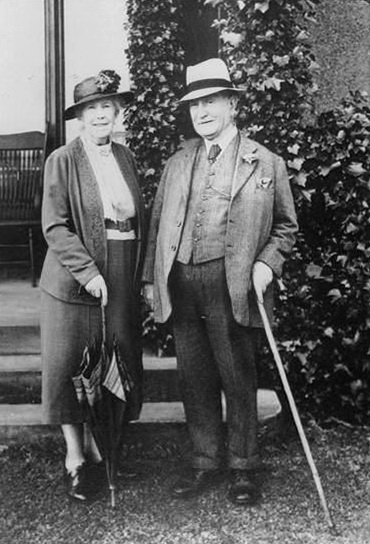
Sir Thomas and
Lady Edith Dixon
In 1918, Edith Clark, daughter of Mr. Stewart Clark, came to live at the house with her husband, Sir Thomas Dixon. This was one of many of their homes and they further enlarged the home and estate, enjoying house and garden parties there.

In 1947, the house was donated to the Northern Ireland Hospitals Authority. It had become too big for the elderly Dixons and they hoped it would be used as a convalescent home and hospital. It opened as a convalescent home in 1950, but finding funds to run such a large building was difficult, so it was eventually closed in 1986. It has been left derelict for many years and is now reputed to be "one of the most haunted houses in Northern Ireland."

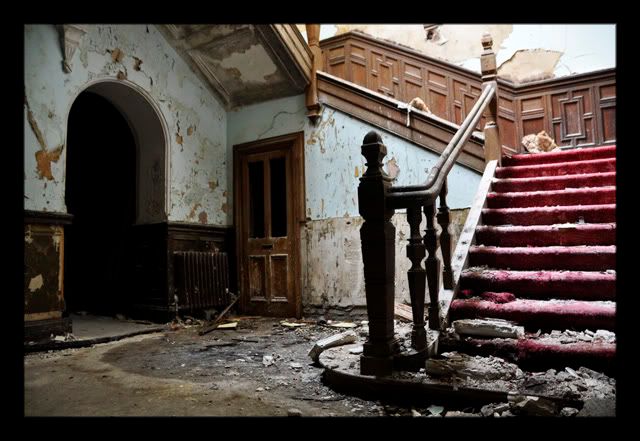

Who haunts Cairndhu House? I'm not sure, although now we can add Rob, Jo, and friend Viv to the list of ghosts.

Wednesday, September 16, 2015

Shutter


Shutter 
by Courtney Alameda
New York: Feiwel and Friends
2015
372 pages
I picked up this book a few months ago and finally got to it. The premise of the story was really appealing to me. We have ghost hunters, vampires, allusions to old stories, all in a rather dystopian plot.

For those of you have not read Dracula by Bram Stoker, you may not remember the main characters of that story and will not understand the references in this book. The characters are:

  • Dracula, a vampire
  • Jonathan Harker, a young London solicitor
  • Miss Mina Murray, Jonathan Harker's fiancée
  • Miss Lucy Westenra, Mina's BFF
  • Dr. John Seward, the head of a lunatic asylum
  • Dr. Abraham Van Helsing, expert in medicine, folklore, and the occult
  • R. M. Renfield, a mad patient of Dr. Seward

Van Helsing confronting Dracula in the 1957 Film, The Horror of Dracula

The families of Helsing, Harker, Stoker, and others are important to our present story. Descending from Abraham Van Helsing, the present heroine of our story, Micheline Helsing, is a member of a proud and active ghost hunting family. They have become the leaders in capturing ghosts, necros (paranecrotic creatures who emerged from the plague graves of the fifteenth century, with a mutated strain of the Black Death), and other monstrous creatures.

Most ghost hunters catch their prey's energy with charged silver panes or mirrors, later dipped in insulating glass to keep the ghost from escaping back into the living world. Micheline, however, has more unusual methods. She uses cameras mainly, not digital cameras but old-fashioned analog cameras and film. She shoots the ghost several times on one frame of film which captures the light and the modified quartz lenses conduct a ghost's electricity. Then the ghost's energy is whittled away by each shot until they are finally sealed into the film's silver halide trap.


Micheline has a reputation for never having failed in a hunt.

Our story begins with a cry for help at Saint Mary's Hospital. People are dying in terrible ways. A ghostly presence has taken over one of the floors and has mutilated some of the patients, nurses, and doctors. There is chaos and commotion everywhere. Micheline arrives first, before her helpers, and makes a split second decision to go in alone and do what she can. She rushes inside without looking back.

Any of us can tell that this was a very bad idea. And sure enough, disaster befalls Micheline and her helpers--Ryder, Luke, and Oliver--who finally show up to help with the capture. But this is no ordinary spirit. This ghost seems intent on revenge against the Helsings, "Hand for hand, and tooth for tooth..."

In the end, the ghost vanishes and Micheline, Ryder, Luke, and Oliver are rushed to the hospital. The ghost has infected them all with something diabolical . Paranecrotic innoculations are begun but to no avail. They are not suffering from necrosis but something even worse--soulchains that tie them to the creature who infected them. Unless they find this creature and destroy it before the end of the week, they themselves will be destroyed.


Micheline and the boys end up on the run, having to deal with their problem. They escape to the Helsing's former compound, abandoned after the disastrous death of Micheline's mother. There, they troupe of ghost hunters makes their center of operations. The evil ghost leads them on a destructive rampage through the city, bringing mutilations and death in order to set a trap Micheline.

Who is this diabolical ghost with a grudge against Micheline and the Helsings? That revelation almost stops Micheline in her tracks. But this is not the end of the story; there is an even bigger surprise in store for the Helsings that could lead to the end of that family completely.

This book is by a fellow graduate from my alma mater, Brigham Young University. Courtney Alameda graduated with a degree in English Literature with an emphasis in Creative Writing. The back cover blurb also tells me that she is also a librarian!

I  think, because of the technical language and the descriptions of gore and violence, this would be a more suitable story for older teens, 15 years and up.

Saturday, July 18, 2015

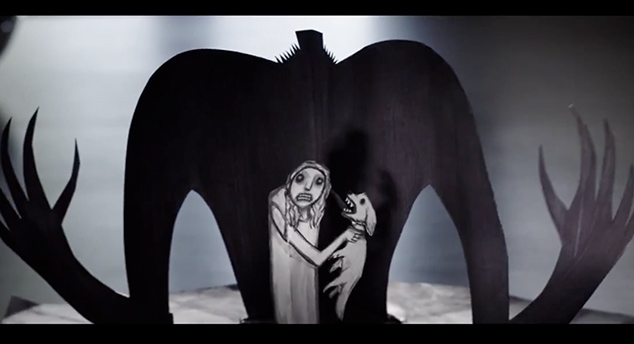
The Babadook


The Babadook
Starring Essie  Davis and Noah Wiseman
Directed by Jennifer Kent
Produced by Causeway Films
2014
Unrated

Most of you might not know this about me, but I taught a Children's Literature class at Saint Mary's College this past Spring Semester. I love children's books, especially fantasy. It is no wonder then that when I read the blurb on this movie that I had to see it. It centers around a children's picture book! How great is that?!

Also, not many horror movies get 5 star ratings from viewers or 98% ratings from Rotten Tomatoes. That alone told me that this directorial debut movie from Jennifer Kent, who also wrote the story, was going to be something worth watching.

Amelia is a widow, having lost her husband in a horribly tragic accident on the way to giving birth to their son, Sam. She has had to take care of Sam alone for about six years now, and she has never really recovered from her husband's death. Add to this the fact that Sam is a handful! He is a child who has tantrums, mainly caused by fear, I think. Every night, he wakes in terror of monsters under the bed or in the closet, and his mother has to check and examine every nook and cranny. In the end, he usually ends up in bed with her, and Amelia is never able to get enough rest.

As part of his fear, Sam constructs various weapons to fight the monsters and protect his mother from them. Early in the film, he gets into trouble because he brings one of his rather scary and potentially dangerous weapons to school. Amelia, in desperation and exhaustion, decides to remove her unusual son from the school rather than figure out how to help him fit in better. It is all too overwhelming to her.

As part of their routine in the evening, Sam is allowed to select books for his bedtime story. One evening, he selects a picture pop-up book called Mr. Babadook. 


Amelia doesn't recognize this one. Where did it come from? She begins to read.


This is creepy and sounds much to familiar. Could this be why Sam is having nightmares?

The pictures get worse and worse, showing strangely familiar figures committing horrifying acts. Amelia cannot finish and hides the book so that Sam won't choose it again.


But this is a horror movie, so you can guess what happens! The book returns to the book shelf and more pictures appear. Amelia goes so far as to tear up the book and throw it away in the trash.

Now the story gets much too realistic and scary for some people. Amelia starts to see shadows that move and hears noises that shouldn't be there. The call of "Baba Dook-Dook-Dook"  can be heard in the house. Sam has a seizure, from seeing the Babadook, and Amelia is feeling helpless to understand or help.

Is the Babadook real or only in Sam's imagination? We think it might be all in Sam's imagination until we then see the book, reassembled, on the front porch. 

I don't want to give away too much of this story because it is one any fan of horror will want to see. It is a great story of mother-child relationships and love, possession, childhood fear, and madness. The Babadook, so like the Boogeyman most of us have imagined at one time or other, is depicted as a large black man/monster with a top hat and large teeth. He can walk, climb, fly, and pass through walls, so nowhere is really safe from him. Every child's nightmare, right?

The Babadook depicts every mother's nightmare, too: the slow descent into madness caused by isolation, lack of sufficient rest, constant problem-solving, and inability to help your child when there is a problem. Kids can drive you crazy, usually not literally, but having to deal with them all the time by yourself is very daunting to even a strong mother. Amelia is already fragile from the loss of her husband, so she is an easy victim of the monster that wants in.

Jennifer Kent, the director, made her debut with this movie and it premiered at the January 2014 Sundance Festival in Park City, Utah--a festival I have attended myself and where many great new films by independent filmmakers are shown. It was released in November 2014 in the States, and came out on DVD in April 2015. It was described as a fresh new style of horror with no gore and jump scares, but real psychological horror. Kent relied more in her writing and filming on the horror classics, analyzing what made them scary to audiences. It is possible to see elements of  Nosferatu, The Shining, Halloween, Let the Right One In, and others in this story. 

Really there are only two main actors in this film, Essie Davis and Noah Wiseman. They are both excellent and realistic in their parts. I am excited to find out what other roles Essie Davis has done. Her portrayal of a tired, desperate mother is perfectly executed here. The young boy, Noah, is also convincing in his role. He is a cute little boy who makes you want to either give him big hugs because he is so scared all the time or lock him in a room and run away because he is so strange.

I heartily recommend this movie to anyone who likes horror movies. It is not rated, but I probably would not allow somebody under 13 to watch it without reservations. It probably should get an R for the horror factor. It is pretty intense at times. I did not watch this one alone!

Here is the official trailer for you to watch.


I am really excited now to see what Jennifer Kent does next. I hope it is another horror film!

Monday, April 27, 2015

Fevre Dream


Fevre Dream
by George R. R. Martin
New York: Bantam Books
1982
336 pages


Now that Game of Thrones, George R. R. Martin's magna opera, has become a best-selling series and television phenomenon, some people are going back to read his earlier works. This book is one of those.

I must tell you that I first read this historical fiction novel in about 1990, so well before Game of Thrones was even any sort of thing in popular culture. I read it because I love vampire stories, and the more classic the better. This book fits my requirements very nicely.

This is the story of Captain Abner Marsh, an almost has-been steamship captain who has lost most of his fleet of ships that move up and down the Fevre River and Upper Mississippi. He meets a very strange man one evening for dinner, by the name of  Joshua York, who has a proposition to make to him. Joshua wants to buy Captain Marsh's business and increase it by building the biggest, finest ship on the Mississippi. In exchange, Marsh will work for him and take him to the lower Mississippi, all the way to New Orleans, and not ask questions. He will have some associates also on board and there may be some mysterious comings and goings, but as long as Captain Marsh asks no questions or gets curious about it, he will be able to run the new fine sternwheeler as he sees fit.

Needless to say, this sounds like a dream come true to Captain Marsh, who thought his business was going under water fast, literally and figuratively. But he wonders about this strange new partner? What is he really after?

The Fevre Dream is born--the most elegant, most deluxe, the fastest sternwheeler on the mighty Mississippi. Wouldn't it be grand if the Fevre Dream could out outrace the famous sternwheeler, the Eclipse? That would be something, all right.

A Steamboat Race on the Mississippi by George F. Fuller, 1858
Abner Marsh is well pleased with himself.

That is, until Joshua York starts acting oddly. Why does he always come out of his cabin at night? Why is he always reading newspaper stories about mysterious deaths along the river? Where does he go on shore, sometimes for days, only meeting up with the ship later downriver. What is going on with Joshua? But Captain Marsh made a promise not to meddle.

Now, all of you readers of this blog post know that Captain Marsh is going to meddle. And he does. He learns something rather chilling about his partner, and yet it is okay. Joshua is not the bad character of this story, but there is someone else who is. That "man" is the reason for Joshua York's nightly excursions.

This book is very well-written. It has a tight story and the characters and setting are fully described. I like the descriptions of the river and river life. I won't go into detail about vampires, although you probably have guessed that Joshua York is one, but he obeys all of the typical rules: no sunlight, burning skin, drinks blood (or does he?), mesmerizes humans, etc. Joshua does some other more unusual things, such as eats food occasionally, is more social than other vampires that we have met in traditional stories; doesn't see humans only as dinner; and is not afraid of mirrors, holy water, or crucifixes. Other vampires in the story enlarge and change the meaning of what it is to be a vampire in Martin's world.

For those of you who are interested, this book has been turned into a graphic novel. It is not in print any longer, but used copies can be found. I have not read it yet, but I have seen some of the pictures online. I guess I prefer to form my own pictures of the story in my own imagination.

Joshua York in the graphic novel version
So, for a good historical vampire story, I heartily recommend Fevre Dream for readers who like George R. R. Martin books, good vampire stories, or quirky historical fiction.

Recommended for ages 16 and older, for violence and gory descriptions.

Sunday, March 1, 2015

Far Far Away


Far Far Away
by Tom McNeal
New York: Alfred A. Knopf
2013
371 pages


Recently I read this book by Tom McNeal. It was voted one of YALSA's (Young Adult Library Services Association) Teen Top Ten books for 2014. On the back cover, I was promised this:

this is the strange and fateful tale of a boy, a girl, and an ancient ghost.

Ok, this book has my full attention! Strange and fateful tale? Ancient ghost?!

Jeremy Johnson Johnson is the anti-hero of our story. Why do I say anti-hero? Jeremy is a very shy teen who lives in an apartment above The Two Book Bookstore, the bookstore left by his grandfather that sold only two books, both volumes of his grandfather's biography. Jeremy's mother is gone, run away with a man she met at the local baker. His father is heartbroken and never comes out of his apartment, instead choosing to waste away in mourning, barely paying attention to what is going on with his son.

And Jeremy has problems. He is considered to be a strange young man, always talking to himself but no one talking to him. Except for a ghost.

The ghost, our narrator, is one of the parts of the story that I appreciated most. This is not a hair-raising ghost, but a protective ghost who has pledged to help Jeremy if he can. I hate to divulge the identity of the ghost, but he fits in nicely with fairy tale theme of the book.

The only human who regularly talks to Jeremy is Ginger Boultinghouse, a wild girl with wild hair and wild ideas.

Early in the story Ginger invites Jeremy to go with her to the bakery in town, the Green Oven Bakery, to have Prince Cake with her and her friends. Prince Cake is a specialty of the Swedish Baker, Mr. Blix, who only makes it occasionally and then signals the town with green smoke from his chimney. The Prince Cake has a local reputation and people half believed that whatever living thing you saw upon eating the first bite would steal your heart away. The only way to break the enchantment was by the touch of a salted tear upon the parted lips of the spellbound.

Prinsesstårta, or Prince Cake in our story, is a traditional Swedish cake
of light sponge, whipped cream, jam, and covered in a light green marzipan.

Jeremy has worries about Prince Cake, since rumours say that his mother ran away because of it.

Surviving his first trip to the bakery, Jeremy falls in with an impetuous plan of Ginger's. She, her two girl friends, and Jeremy break into the baker's home and play a big joke on him. This one simple, thoughtless act leads to the horror that is to follow, putting Jeremy and Ginger into severe danger that even his ghost friend has trouble getting him out of.

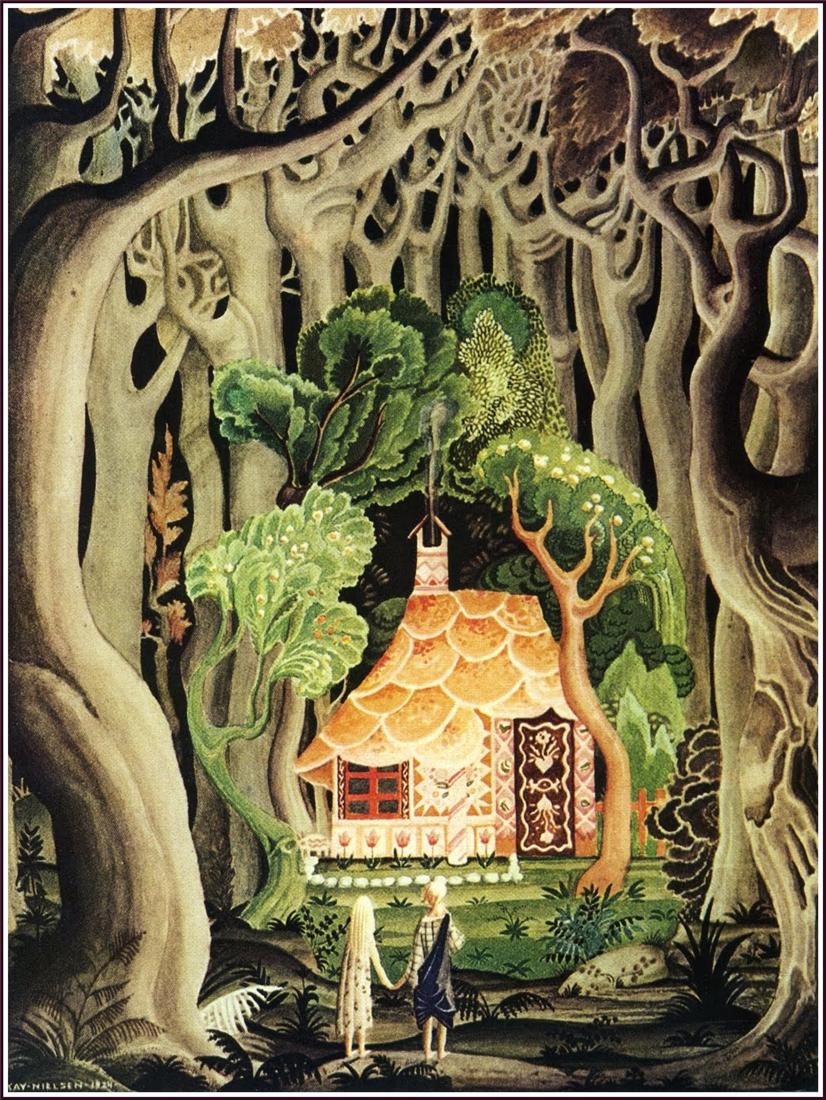
I mentioned earlier that this book has a fairy tale feel to it. The setting, a small town called Never Better, seems to be right out of a fairy tale, superficially a nice place to live until you dig around and find something nasty under a rock, including a lot of inexplicably missing children. Several of the characters seem straight out of stories, and our ghost, who I think is the true hero besides being narrator of the story, is definitely connected to fairy tales. It can be amusing to discover how many tales are alluded to in the book. Mr. Blix tells stories, the deputy tells and listens to stories, and even Jeremy's absent mother's only gifts to her son are actual stories in books.

The main plot of this book, however, revolves around a very well known tale, and one that turns strange and scary for our two main characters, Jeremy and Ginger.


I confess I had a very hard time putting this book down. I got so caught up with Jeremy and Ginger and the action of the story that I stayed up most of one night to keep reading. Tom McNeal is a truly a master storyteller about the mastery of stories.

Highly recommended for ages 13 and up.


Sunday, February 22, 2015

The Coldest Girl in Coldtown


The Coldest Girl in Coldtown
by Holly Black
New York: Hachette Audio
2013
Read by Christine Lakin
10 sound discs (12 hours)


For the last few weeks, I have been listening to this book in the car. By popular author, Holly Black, this is one of the best vampire stories I have heard in a long time. No wonder it was voted one of the best fiction books for young adults by the Young Adult Library Services Association (YALSA), and an amazing audiobook for young adults (also by YALSA) in 2014. It is on several lists of best horror fiction for teens, too.

This story starts out with a horrific bang. Tana, a 17-year-old, wakes up following a party only to discover that all of the other teens have been brutally murdered. As she wanders through the house, she looks for other survivors but only finds blood and guts everywhere. Yes, it is rather graphic. Then she opens a door to a bedroom. There she sees Aidan, a young man (and former boyfriend, it turns out) chained to a bed. In the other bed is another boy, but this guy is different. Tana can tell immediately that he is a vampire.

This is how we find out what sort of story this is. The victims of the house party were mutilated by thirsty, very savage vampires, who purposely left Aiden and Gavriel, the "boy" vampire in the bedroom.

Tana has moments to figure out what she should do. How can she get away? She doesn't know where the vampires are in the house, but she knows they are there, probably sleeping off their glutonous feast since it is still the remains of the day. That doesn't leave her much time. And what she she do about the vampire who is tied up?

Springfield is the Coldtown of our story.
Through the masterful telling of this story, we learn that events such as the party massacre are not unusual. Vampires are real and out there, but society has mostly dealt with them by locking them into various "coldtowns", called such because of the sickness and feeling that takes over one's body as it changes. Coldtowns are all over the United States, and people on the outside can see in through the active use of social media.

There seems to be the impression that Coldtowns are fun, party towns where vampires live forever, dancing and feasting. This lifestyle is appealing to some young people who escape into the Coldtowns hoping to be changed and party forever, only to die tragic deaths as food for the vampires who eat too quickly. Not all victims will be turned, however, but only those who are bled slowly and then have a chance to feed themselves.

I was particularly pleased with Holly Black's more traditional portrayal yet updated of vampires. They are seen as mesmerizing and erotic to their victims, once bitten. They also sleep in the day, can't survive in the daylight, and also have an uncontrollable need to feed. Her descriptions of their ability to sense the blood around them, in living victims, is very vivid and helps us to understand the immediate change in the brain, once the person becomes infected. These are very much ancient vampires who have adapted well to the clubbing activities of many teens, using this as the means to entice new meals into Coldtowns.

The story as to who Gavriel is, and the conflicts between him and the ancient and powerful Coldtown vampire, Lucien, is well described and exciting. Tana and Gavriel are attracted to each other, something no other vampire in the story expected since Gavriel has been known during his long life as being maniacally cruel, a history Tana did not know before she rescued him from the farmhouse party. This leads to some interesting plot twists.

I hate to think of Tana, who was infected during her time in Coldtown and must wait to see if she changes, as being a vampire forever. She has a humanity that most of the characters, human and vampire alike, lack. But we know that she will "survive" any way that she can, and maybe make Coldtown a better place.

Here is a book trailer for you about the story:


I recommend this book for older teens, maybe high school and up, who love traditional vampire stories. Some of the gore in the story, as well as the intensity of the violence, might be too much for younger readers.

Tuesday, January 13, 2015

Ghost House


Ghost House
by Alexandra Adornetto
Grand Haven, MI: Brilliance Audio
2014
Performed by Emily Foster
8 audio discs/9 hours


Everyone who knows me, knows that I enjoy haunted house stories. So it was no wonder that I picked up Ghost House by Alexandra Adornetto, author of the Halo Trilogy, to listen to in my car.

Briefly, Chloe Kennedy has been seeing ghosts from a young age. Her mother had helped her with this rather scary problem by telling her to tell the ghosts to go away and, miraculously, they did, for a long time. But now Chloe's mother has died unexpectedly and Chloe is devastated. 

Now, I am not sure that it was a good idea to take a young girl who sees ghosts to an old English manor house, but Chloe's British grandmother owns one and that's where Chloe ends up to have a break and recover from her mother's death. I guess she is distracted from her own personal tragedy, at least. Grange Hall, Chloe's granny's home, is full of rather frightening apparations--hanging men on trees, a ghoul in her closet, and a handsome young man who can actually converse with Chloe, something that hasn't happened before.


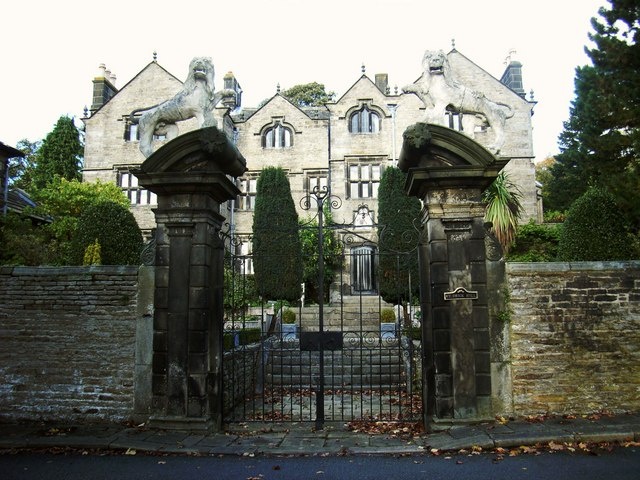
Kildwick Hall, Grange Road, Kildwick in North Yorkshire
Grange Hall in this book might look something like this.

Alexander Reade, Chloe discovers, has been dead for 157 years. But because he is more real than any other ghost she has met or seen, she forgets that he is a ghost. Being really good-looking and engaging doesn't hurt anything either.

Through Alexander, Chloe learns the secret behind the hauntings of Grange Hall. The matter becomes quite urgent as ancient jealousies remain in play and become focused onto Chloe, threatening the house, Chloe's grandmother, and Chloe herself.

This story has good moments: I really enjoyed most of the interactions between Chloe and Alexander, although some of them seemed rather contrived. Would Chloe really forget that Alex was a ghost? I rather think not.

What I don't get about this story was that it took so very long (nearly to the end of the book) to actually ask Alexander what happened to him, how he really died, and who else is haunting the Grange. If I were a high-school aged girl who could see ghosts, I would be asking the first one who could talk back to me about how he died. Isn't that the way to help them pass on? I mean, wouldn't she be curious about that? I certainly would be. Instead we get a lot of flirting and angry ghosts inexplicably throwing things around. 

If I were to make this story stronger, I would probably have allowed Chloe to be more of a detective, asking more questions of the ghosts she can talk to, and doing more research to find out the background of Grange Hall and the Reade family who lived there. The writing, too, was rather all over and uneven. The back and forth with the past and present didn't always flow well, and I wanted to yell at Chloe a lot of the time that Alexander wasn't nearly as interesting as the young live man in front of her who is also trying to get her attention.

So, anyway, this book is okay but not great. I think if you are keen on ghost stories and not particularly picky, you will want to try this one, but don't expect the best ghost story you ever read.

Sunday, November 23, 2014


Blood Sinister
by Celia Rees
Tulamarine, Vic.: Bolina Audio
2007
Performed by Shirley Barthelmie
5 sound discs (5 hours, 10 minutes)


Do you like a good vampire story? I do. And don't give me any sparkly vampires in love. I am more a Dracula traditionalist when it comes to vampire stories--darkness, casket in the cellar, menacing and driven to feed, and stake through the heart. Thankfully, Celia Rees has provided these elements in her tale, and I was not forced to turn off the recording in disgust.

Ellen is a terminally ill teen and nobody seems to know what is wrong with her, only that she seems to have a rare blood disorder. She is essentially wasting away and her mother and grandmother treat her like a piece of very delicate china. Of course, this makes her a little disgruntled, since all Ellen wants is to be normal and do normal teen things. Her mother sends her to stay with her grandmother who is nearer to the doctors being consulted on her problem. How convenient that Grandma lives right across the street from a very large, creepy cemetery!

Remember Highgate from the Graveyard Book?

While Ellen is lounging around trying not to overdo it, she discovers a trunk of old  papers, photos, and diaries in the attic. These are documents by her famous great-great-grandmother Ellen (I'll call her Ellen 1) who became a famous doctor in the late 1800s. Of course, teen Ellen can't resist reading the diaries of her famous ancestress; besides it's something to do.

Soon, Ellen becomes fascinated on the point of obsession with the diaries. Ellen 1 describes her life as the daughter of a doctor, and one of his patients is a count from central Europe is quite mysterious. Teen Ellen thinks, as she reads, that this man sounds very much like a vampire, with his strange habits, and she becomes quite worried about Ellen 1's relationship with this man. Her doctor father is forcing her to spend more and more time with him and his strange sister, who start to buy her gifts and then make plans for her to travel with them. How will she get out of it?

Teen Ellen is relieved from some reading anxieties by a friend's visit from her own past. She begins to tell Andy about the diaries and he also becomes fascinating, adding that he has heard of vampires lurking in the cemetery across the street.

As Ellen reads further into the story of Ellen 1, events surrounding her also become more mysterious, especially when she gets a new doctor to treat her strange condition. Who is this American doctor and why does he know so much about her and her great-great-grandmother? Luckily Ellen has Andy and other friends to help her in the end.

I liked the historical/horror fiction combination here. Some might find it confusing to go back and forth between Ellen 1 and Teen Ellen, but with the audio book I was able to keep their stories straight quite well. I could see the obvious connection to the old Bram Stoker story, and since this is my ideal for vampire stories, I enjoyed Blood Sinister quite alot. 

Amity


Amity
by Micol Ostow
New York: Egmont
2014
361 pages


Most people are familiar with the story The Amityville Horror, either in book or film form. The movie version with Margot Kidder and James Brolin was one of the first haunted house movies I was allowed to watch.


I remember when the story of the Lutz family was published in such magazines as Good Housekeeping. There are so many websites about them and their house, and people are still debating as to whether or not they were telling the truth. The movie has been updated and sequelized and prequelized and transformed so often that it is unrecognizable. This story has probably influenced all haunted house movies and books since it came out.

Of course, the house still stands and people live in it, quite happily by most accounts. But ghost hunters and gawkers still make pilgrimages to see the famous house.

Micol Ostow, a New Yorker, has taken up the challenge of writing a new fictional teen story about the Amityville house. Our story is split between a time about ten years ago, following Connor and his dysfunctional family's move into the house, and Gwen with her family in the present day. Both families have hopes for a new beginning in this house, but the house has other ideas. And yes, this house seems to be alive with a plan of its own for its occupants.

Slowly, in both timelines, our main characters respond to the house. Weird noises are heard, the boat house door bangs and taunts. Various family members see things or respond violently to the atmosphere of the house and have to leave. We end up uncertain as to whether our two main characters are victims or are tools of destruction.

This story does maintain some of the horror and tension needed for a scary story, although I was rather distracted by all of the back and forth, including a change in the fonts for Connor's story and Gwen's. I think I would have preferred having Connor's story as background, and maybe a merging of stories at the end. It is also told by the characters themselves, and possibly that in itself detracted from the horror. I think it is hard to convey the horror of the situation through one person's limited point of view. I don't get the impression that some characters, such as either mother, really seem to notice the atmosphere of the house or the strange behavior of their children.

I think Amity was worth reading, but it wasn't as frightening as it could have been. I'm somewhat disappointed since this story is so familiar. But if you are a collector of haunted house stories, as I am, you should give it a try.

It doesn't look like a haunted house, does it?


Sunday, November 9, 2014

The 5th Wave


The 5th Wave
by Rick Yancey
Holland, OH: Dreamscape Media
2013
Performed by Phoebe Strole and Brandon Espinoza
10 sound discs (12 hours 42 minutes)


Recently, teens were allowed to vote for their favorite Top Ten Books in YALSA's (Young Adult Library Services Association) book challenge. The 5th Wave was on the list of  25 titles popular among teens right now, but it was not chosen. Personally, I am rather disappointed about this because I really like this book! It definitely is one of my Top Ten on that list!

In a sea of dystopian fiction for teenagers right now, this book stands out as being different.Instead of the world falling apart due to human actions through war, stupidity, or disease, this story revolves around the end of life as we know it due to an unusual alien invasion.

Let me explain the Waves:
  1. The First Wave was a massive EMP strike (revisit electromagnet pulses in Ilsa Bick's trilogy) that shorted out all forms of technology and electrical devices. Think about when the power goes out at your house. What can you do? Not a lot, unless you have some things that run on batteries or gas. And if you are lucky, you can always go stay with a friend or at a hotel. But what if everyone's power was out all over the world? Not only would your lights not work in an EMP strike, but your cell phone, your car battery, etc. would not function.
  2. The Second Wave was a tsunami wave, created by the Others when they dropped some form of metal rod from the upper atmosphere onto one of the earth's fault lines. Coastal cities on all seven continents were wiped out, including huge cities such as New York and Los Angeles.
  3. The Third Wave was a formidable plague that wiped out ninety-seven percent of the remaining human population. Also called the "blood plague," the Others engineered a virus so quickly fatal that humans didn't have a chance to even find a cure. Not all people who contracted the plague died. Ben was the sole survivor in his family, but nobody knows why some people were spared.
  4. The Fourth Wave was a group of silencers, people previously embedded with alien consciousnesses and awakened to their alien self, who travel the countryside, shooting any humans they discover.
Our story begins in the middle of the Fourth Wave, when humans are huddling together in small communities, waiting and wondering what is next for them. There is a giant spaceship in the sky which no one has managed to contact or, as is more likely, the aliens are purposely ignoring the contact. People had thought the aliens would be interested in meeting them, with visions of an E.T. visit, but it has turned out to be more like the War of the Worlds, without the happy-ish ending.

Scene from the 1953 version of The War of the Worlds

Cassie, her father and brother, Sam, are living in a camp of survivors. Things are okay, not great, but at least they are together. Cassie's mother and many of her friends and neighbors had died of the plague.

One day, they hear the sound of buses rumbling into the camp. It's the army to rescue! Or is it? The buses turn out to be older school buses and the army personnel who come with them start rounding up all of the children. They tell the adults that they are taking the smallest children to the closest military base for safety and then more buses will return for them. Most parents seem unhappy about this, but they want their children to be safe. When Cassie's and Sam's turn comes to board the bus, Cassie is not allowed on--only Sam is wanted. Cassie, being protective of her brother and adamant about the small family staying together, argues that either she goes or Sam stays. In the end, Sam goes without Cassie but gives her his teddy bear to keep her safe, with the hopes that she will return it soon.

After the buses leave, the rest are rounded up into the buildings. Cassie starts to get suspicious about what is happening, only to have her fears confirmed. She only manages to escape by hiding in the nearby ash pit, comprised of the ashes of the dead.

I don't to tell you how this story comes out because I want you to read it, but Cassie, in her quest to find and rescue her brother from murderers, discovers the true nature of the Fifth Wave. She learns that she isn't the only human on earth, which worried her for a while, and that not all of the "others" are cruel destroyers of all human life. She learns to trust again, although doing so leaves her very exposed physically, mentally, and emotionally.

I particularly like Cassie as a main female character. She reminds me somewhat of Alex in the Ilsa Bick trilogy in the way she, as an ordinary high school girl, finds the strength and smarts to survive in the wilderness. Neither girl really knows what is happening or why. I know plenty of young women who would probably feel lost and helpless without their cell phones and the internet to tell them what to do or what is going on. The drive and urgency to help another person or people to survive, too, also plays a part in both stories, and maybe that helps them carry on and not give up despite the odds.

There are also two very strong male characters: Ben (Zombie) and Evan Walker. Ben has the guts to stick up for younger kids in the military camp. He is the main reason that Cassie's little brother, Sam, is able to deal with what has happened to him. Evan Walker is a mystery and I can't wait to find out how his character develops and interacts with the other human characters.

I liked the audio version of this story. We have two readers, Brandon Espinoza and Phoebe Strole. It makes sense in this story since we switch back and forth between Cassie and Evan and Ben. Both readers are smooth and engaging. I look forward to hearing more from them in the second volume.

The movie version is being cast as we speak. It is due to come out in January 2016. I can't wait!


Monday, September 29, 2014

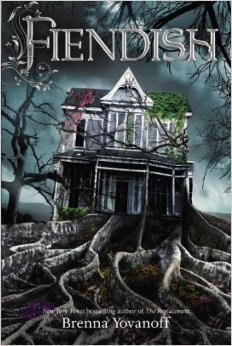
Fiendish


Fiendish
by Brenna Yovanoff
New York: Razor Bill
2014
341 pages


I have seen a newish trend in teen fiction emerging--the Southern Gothic. Maybe it's not so new, since we have seen popular books like Beautiful Creatures by Kami Garcia, and from my earlier review, Spirit and Dust by Rosemary Clement-Moore, but I have seen more of this particular sub-genre in the reviews. This is my first Brenna Yovanoff book, but I am eager to read more.

Fiendish is an entertaining Southern Gothic with a paranormal twist. I found these elements of the Gothic Novel very nicely outlined by Robert Harris. Here's their application to this novel.

  • We have the actually have several large and spooky houses. We have the burnt-down house in which Clementine was found. We have her aunt Myloria's decrepit house. We also have Fisher's grandmother's house, with the mysterious rooms in the attic.
  • The first element of mystery in this story is how did Clementine get into the cellar closet and subsequently survive, and who put her in there?
  • There are ancient prophecies, omens, portents, and visions in abundance about the "Crooked people" of Hoax County. The return of the Reckoning, when the town's people tried to burn out the Blackwoods' home, is what people of the craft are afraid of.
  • There are many supernatural elements: how did Clementine survive all of those years in the cellar? What about the hollow and the fiends? And the hell dogs are deadly. 
  • The high, overwrought emotion is everywhere in this story: Aunt Myloria's strange behavior, the animosity between the village and the hollow dwellers, the overwhelming sense of doom, all contribute to the highly charged emotional level of the story.
  • Women in distress is also a common theme in the Gothic novel. Clementine, her cousin Shiny, friend Rae and, most of all, Davenport, all are threatened by the past, the town's people, the hollow fiends, and even each other.
  • The metonymy of doom and gloom. We have plenty of metaphors in the wind howling, the rain flooding the rivers, and the dark smoke of the burning buildings.
  • And the use of language to create a dark and tense atmosphere.
The spooky, swampy hollows
As a Gothic horror story, this story was exciting and intense. I really enjoyed the side romance, too, with Clementine and Fisher, brought together in the beginning of the story by some mysterious connection. It's the typical teen romance, on again off again, but also rather intense as Clementine is so drawn to her rescuer. The characters face their opponents with strength and determination, and although we aren't quite sure how it will end, we know our story's heroes will put up a good fight. I did wonder

I recommend this book for any teen reader who likes horror stories but doesn't mind a touch of the supernatural.

Thursday, August 28, 2014

Ammie, Come Home


Ammie, Come Home
by Barbara Michaels
New York: HarperCollins
2009
352 pages
eBook version

I may have told you before that I discovered Barbara Michaels' books when I was a teen. I have loved her gothic thrillers ever since and when I am looking for a comfort book to read, I often will pull out one of her titles. This month I reread the old favorite, Ammie, Come Home. Although it seems rather dated, with the references to hippie culture, I still find the historical ghost story appealing.

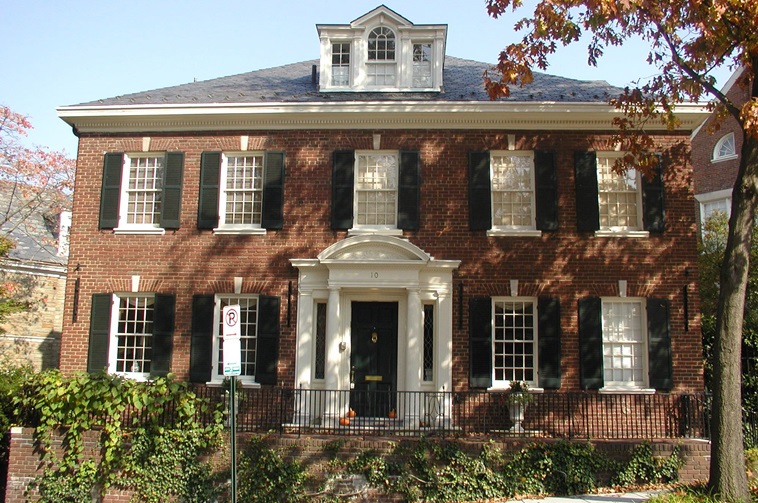
Ruth Bennett  lives in a beautiful old Georgian home in Georgetown. She has inherited it from an older relation whom she didn't know that well, but Ruth loves the history and elegance of the neighborhood and the house. She has recently invited her niece, Sara, to come live with her while she attends the nearby university, and she is glad for the company. But this is when things start to happen in the house.

A Georgian-style Home

It is little things that begin to unnerve the two women. A lonely voice in the night calling, "Ammie, come home!" awakens Sara, who wonders what small pet is lost in the dark. There is a feeling of cold in the parlor that is uncomfortable but not unbearable to both women.

Then Ruth meets dashing Pat McDougal, professor of Sara, who invites her to his mother's home for dinner. There she meets a famous medium--of course!--and promptly and uncharacteristically invites her to her own home to do a reading.This is when the true haunting begins!

The ghost story develops well, with the characters doing their historical research on the house to see if they can find out who is stuck there. It turns out that it is more than one ghost anchored there due to a past tragedy, which leads to confusion and difficulties for Ruth and Sara, along with their friends, Pat and Sara's boyfriend, Bruce. The ghostly possessions and apparitional appearances increase in frequency and intensity until we reach a terrifying climax.

Although this book, first published in 1968, is somewhat dated in some ways and I never quite forget that I am reading a story about characters in the hippie '60s, I think the characters are developed well  I feel connected to them. It is rather strange and unbelievable, however, how quickly the relationship between Ruth and Professor Pat progresses. But because I like Ruth and Pat, I can disregard the swiftness of their romance.

During this reading, I discovered that Ammie, Come Home had been made into a television movie! It stars legends Barbara Stanwyck and Richard Egan. The House that Would Not Die (1970) changes the story somewhat. There is still a house, but it is in the country, not the city, and Ruth has left her job for a time to decide if she wants to live there. Sara is there with her, but it is unclear why she is hanging out with her auntie in the country since the college connection is lost. Pat McDougal is now a neighbor, and there is no Mrs. Mac, his mother, the hostess with the most-est in Georgetown. She is replaced with with an aunt who is far more bland. Bruce, the boyfriend, is mysteriously replaced by Stan, and I confess that I don't like him much.

Despite these changes, I greatly enjoyed the movie and considering it was made for television, it is a satisfying ghost story for a Saturday afternoon. It is divided into parts on Youtube. Here is part one for you to get started:


An added bonus for me in finding The House That Would Not Die was finding the Youtube station TV Terror Land. Imagine finding 1970s-1980s scary television shows that you thought you would never see again! There will be more reviews on some of those shows later!

Sunday, June 15, 2014

Dorothy Must Die


Dorothy Must Die
by Danielle Paige
New York: Harper
2014
452 pages


For all of you Oz fans out there, how about a dypstopian story about Dorothy, the Wizard, and all of the strange inhabitants we have met in the Emerald City?

Amy Gumm lives in a trailer in Kansas with her mother, an alcoholic who doesn't pay much attention to what is going on in Amy's life. Then along comes a tornado. Amy is left to hold the fort, as her mother has left her and Star, the family's pet rat, to take care of themselves in the upcoming disaster. Amy has nowhere to hide and she is taken up in the storm, twirling around in the trailer.

Immediately upon landing with a thud, Amy finds herself at the top of a precipice. Handily, a beautiful and strange young man is there to help her out of the trailer before it falls crashing to the bottom of the cliff. The mysterious young man welcomes her to Oz, but this isn't the Oz of the stories Amy has heard. The countryside is devoid of crops and color. Where did the lovely Munchkin blue go?

The strange young man explains to Amy that Dorothy, once she became Princess of Oz, became addicted to magic and now mines it from the land and people of Oz. Her laws are strict, even fierce, and her helpers--the Tin Woodman, the Scarecrow, and the Cowardly Lion--frighten, imprison, and punish the Oz population if they do not happily cooperate. And the Oz citizens must be happy, or else the Scarecrow, a nightmarish mad scientist figure in this story, will give them an "Attitude Adjustment."

The witches of Oz are divided. Glinda, the Good Witch, is key in the mining operations and is instrumental in making Dorothy's whims a reality. The other witches, however, those that we have always thought of as "Wicked," are united in The Order of the Wicked and are excited to find a girl from the Other Place who is their only hope to defeat Dorothy in her conquest of Oz. In this Oz, the roles of Wicked and Good are reversed, although the witches are not entirely Good, either. They are longing for the old days, when they were free to terrorize the land. They trap Amy into helping with their cause, convincing her that she is the only one who can set Oz to rights again. And the only way to do that is to kill Dorothy and end her reign of terror.

There is a lot of action in this story, and Amy's fumbling to spy on Dorothy and her household, makes the story interesting. Amy is a smart, capable, and strong female character, but she would be the first to say that she doesn't know what she is doing. I can appreciate that in a book character. I also enjoyed meeting other personalities along the way, including Nox, another Order member who teaches Amy about magic; Star, the amazing rodent; Ollie, the wingless monkey who helps Amy along the way; Jellia, the head maid in the palace; and Pete, the mysterious young man who is not who Amy thought he was.

I even experienced a furtive enjoyment in meeting the Wizard, who can't be trusted to be on either side, and the crazy, evil Scarecrow, who eats the brains of smart, magical creatures so that he can be smarter.

Surprisingly, this book is only the beginning of the story. Dorothy gets away and Amy gains surprising allies. But what comes next? We will have to wait for the next installment from Danielle Paige. I know I can't wait for it!

Thursday, May 15, 2014

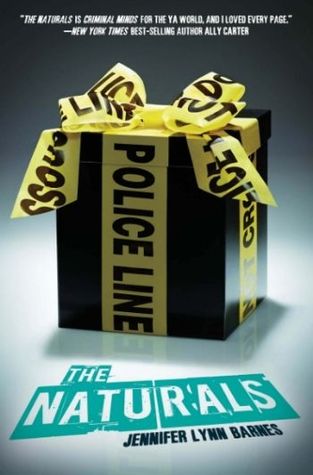
The Naturals

The Naturals
by Jennifer Lynn Barnes
New York: Hyperion
2013
308 pages


This book will remove many of you of Spirit and Dust by Rosemary Clement-Moore, reviewed in this blog. This story is also about a sassy psychic teen girl who is asked to assist the FBI with their investigations. This book also has cute boy protagonists who are also helping the FBI in various ways. This book, however, has a very real, versus supernatural, criminal.

This red-headed psychic is seventeen-year-old Cassie. She can read people by observing even the minutest details and can tell all sorts of things about that person's life, personality, and behavior. Cassie lives with her grandmother on her father's side. Her father works for the government and is often gone, and her mother, a "psychic" performer was mysteriously murdered in her dressing room several years before this story takes place. Cassie was the one to discover the crime scene and has been haunted by the experience. Her mother's body was never found, and the case never solved.

 One day at work, she meets a young man who tells her about the special program run by the FBI for people like her. Cassie is interested in the program, especially as it might help her figure out what happened to her mother. She decides to  join the other "naturals" in Washington, D.C. to help solve cold cases. Needless to say, her grandmother is not happy with her moving away, but Agent Briggs, who is in charge of the program, convinces them that it would be a great opportunity for Cassie.

In D.C., Cassie meets other young people involved in the program. She is attracted to Michael, the young man who first approached her about it, and Dean, a young man with a tragic back story. She starts her work with Agent Lacey Locke,  a determined and ambitious woman who heads up the profiler section of the special program.

Soon after Cassie settles in, she and the other teens learn about a horrible case that Agents Locke and Briggs are working on. Cassie begins to see similarities between the victims and then it becomes evident that there is some connection to her own mother's death.

This story was fairly entertaining. I enjoyed the dynamics between the young teens involved in the program. The ending was a bit of a surprise and I thought there should have been more clues. I wont' give it away, but I thought it was a little unrealistic. There would have been signs to point us and Cassie, who is very good at reading people, to the actual criminal in the case. It also seemed a bit coincidental, but I won't tell you more because that would give too much away.

I think those of you who enjoy watching Psych, The Mentalist, and CSI will enjoy this book. There is a little bit of everything in this book for you: romance, mystery, horror, and even humor.

Uncrashable Dakota

Uncrashable Dakota
by Andy Marino
New York: Henry Holt and Co.
2013
320 pages


For those of you who loved disaster books, as I do, and especially stories about the Titanic, here is an interesting twist. What if the huge ship wasn't a sea-going vessel but rather a gigantic dirigible?

The author, Andy Marino, was very influenced by the Walter Lord story, A Night To Remember, so readers of that famous book will see elements of it in this book. But this isn't just a retelling of the Titanic sinking.

Hollis Dakota is the heir to a vast empire of airships, circa 1912. He, his mother Lucy Dakota, stepfather Jefferson Castor, and stepbrother Ron, are embarking on the maiden voyage of the Wesley Dakota, an unprecedentedly large airship named for Hollis's deceased father. Everything is going well until Hollis's mother, Lucy, is kidnapped by hijackers from their cabin and Hollis has to flee into the bowels of the ship to save himself. With the help of his stepbrother and some interesting steerage characters, Hollis manages to escape detection and work on the rescue of his mother and ultimately the ship. But who are the hijackers? That is part of the surprise of the story.

The ship encounters some of the same fate as the Titanic, hitting another airship and splitting in half. We know that not all of the passengers make it, but we are not told how many go down with the ship.

The technology used to float the massive vessel is described well and is quite unique, I think. I won't give it away since I hope you will read the story yourself. There is some back story given about the Hollis's grandfather and inventor of airship travel, Samuel Dakota, which is relevant to the present day. The mistakes we make in the past can sometimes catch up to us again in the future.

Hollis is a brave and clever boy, but he also has the help of a very clever girl, Delia. I think this is a story that boys or girls can enjoy and find characters with which they can connect.

I recommend this book for teens 14 and up. It is a story full of details, so it might seem longer than the average story. If you stick with it, you will be happy you did.


Friday, March 21, 2014

Thorn Abbey


Thorn Abbey
by Nancy Ohlin
New York: Simon Pulse
2013
295 pages


The title of this new teen horror book reminded me of Gothic horror favorites, alluding to Thornfield in Jane Eyre by Charlotte Bronte and Northanger Abbey by Jane Austen. But the story is essentially a remake of Rebecca by Daphne Du Maurier, one of my all-time favorite books. Could this book live up to it? Well, not really because the goal is too high, but it is an entertaining story nevertheless.

Tess is a shy, insecure, mousey, and very ordinary girl who transfers to Thorn Abbey, a prestigious boarding school. Her new roommate, Devon,  seems friendly at first, until the mention of Max de Villiers comes up. Max was her former roommate, Becca Winters', boyfriend, but Becca died tragically and Max is heartbroken so leave him alone.

Of course, there is an instant connection between Max and Tess and despite Devon's dire warnings, they begin to date. But weird things start to happen to Tess. She hears crying in her dorm room when no one is crying. Someone tries to burn her at the bonfire. The girls' lounge is vandalized. And Max is moody and won't talk about Becca. Tess feels uncertain about his feelings and thinks he is broken up about Becca, who was seemingly perfect in every way.

Thorn Abbey might be like Fettes College,
a prestigious boarding school in Edinburgh, Scotland

The original Rebecca in the Daphne Du Maurier haunts Manderly more figuratively and "gets her revenge" on Max from beyond the grave through a set of circumstances and the mind of a crazy housekeeper. But I she is not an actual spirit walking the halls. Becca Winter, however, is portrayed here as a real ghost with revenge in mind on Max and the school, possessing her former roommate, Devon, and causing her to carry out her deadly schemes from the afterlife.

I think I found the original story far more disturbing. We can easily imagine the young Mrs. de Winter -- young, naive, happy to leave a life of servitude but frightened of the grandiose life she now finds herself thrown into. Everywhere she goes she hears about the perfect Rebecca, the dead wife of her new husband who won't talk about her. How could anyone live up to that? Rebecca doesn't have to do anything at all to be disturbing to us, but having Mrs. Danvers around to emphasize the new wife's inadequacies compared to her beloved Rebecca makes the story even creepier.

Thorn Abbey is a readable story that hangs together well enough, although I found the ending rather silly, like a B horror movie ending. One possession was enough for me. I think teens 14-16 will enjoy the boarding school premise, as well as the ghostly occurrences, even if they haven't read the original classic.